
UK NBA Betting Help: A Numbers-First Guide for British Punters in 2025/26
Numbers, not nudges — your NBA betting playbook for UK punters. Available in US
Why NBA Betting in the UK Needs Its Own Playbook
I logged into a UK book at half past midnight in March, the Lakers down nine to the Nuggets and a Bet Builder slip half-built, and the cash-out price flickered like a stock ticker. By the time I looked up, NBA viewing on Prime Video in the UK had jumped 444% year on year for the 2025/26 season, the O2 Arena had just hosted the biggest NBA London Game ever, and online gambling accounts in Great Britain had pushed past 13.5 million monthly actives. The market changed under my feet, and most of the help articles I read still talked as if it was 2022.
UK NBA betting in 2025/26 is its own beast. Decimal odds dominate. The Gambling Commission tightened financial vulnerability checks to a £150 rolling threshold. A statutory levy now siphons up to 1.1% of every licensed operator's GGY into research and treatment. And the NBA itself moved to a broadcaster pair — Sky Sports plus Prime Video — the previous generation of UK basketball fans never used. None of that lands in the affiliate-driven listicles. This guide does the opposite. Nine years modelling NBA markets for British audiences, line-shopping across UK books, untangling schedule-based handicaps for punters who tip off at 1 a.m. — what follows is a numbers-first playbook for someone who wants to bet the NBA properly and is not interested in being marketed at.
Scope of this guide. Legality, odds maths, every major market type, evaluating a UK book without falling for welcome offers, the strategy core that actually moves return on investment, the £150 threshold and bankroll discipline, the London Game and NBA Europe pipeline, and the integrity backdrop you are quietly betting inside.
Before the long form, here is the boiled-down version for readers who want the bottom line first.
The 60-Second Brief for British NBA Bettors
- NBA betting is legal under a UKGC licence; decimal odds are the standard, not the American minus-110 line.
- The financial vulnerability check kicks in at £150 net deposits over a rolling 30 days — plan your bankroll around that floor.
- UK Prime Video NBA viewing jumped 444% in 2025/26; tip-offs run from 7 p.m. to 4 a.m. GMT.
- The strongest documented edges sit in schedule spots, pace shifts and back-to-back ATS patterns, not in welcome offers.
- Aim for 1-3% per bet, shop two or three UK books per slate, and track closing line value rather than win-loss.
The UK NBA Market at a Glance, 2025/26
Map the British NBA betting market with five numbers and you stop arguing about which book has the prettiest app. Growth and regulatory drag pull in opposite directions, which is why a numbers-first frame matters.
+444%
year-on-year jump in UK NBA viewing on Prime Video in the 2025/26 season.
13.5 million
average monthly active online gambling accounts in Great Britain as of March 2025 — an all-time high.
£7.8 billion
UK remote casino, betting and bingo gross gambling yield in the 2024/25 financial year, up 13.1% year on year.
138 million
global unique viewers for NBA All-Star 2026, the highest reach since 2011 and up 87% year on year.
24%
of UK adults place an online sports bet at least monthly, rising to 52% in the 25-34 cohort.
£150
net-deposit threshold over a rolling 30 days that triggers a financial vulnerability check at every UKGC-licensed book.
The audience is expanding fast, especially under 35. The pot is bigger and the watchers are younger, but the supervisory net is tighter than it was twelve months ago.
NBA Cup 2025 group play pulled 40+ million viewers in the United States, up 90% year on year. The format that British fans barely noticed two seasons ago is now one of the highest-priority tournaments on the calendar, with its own dedicated futures markets at most UK books.
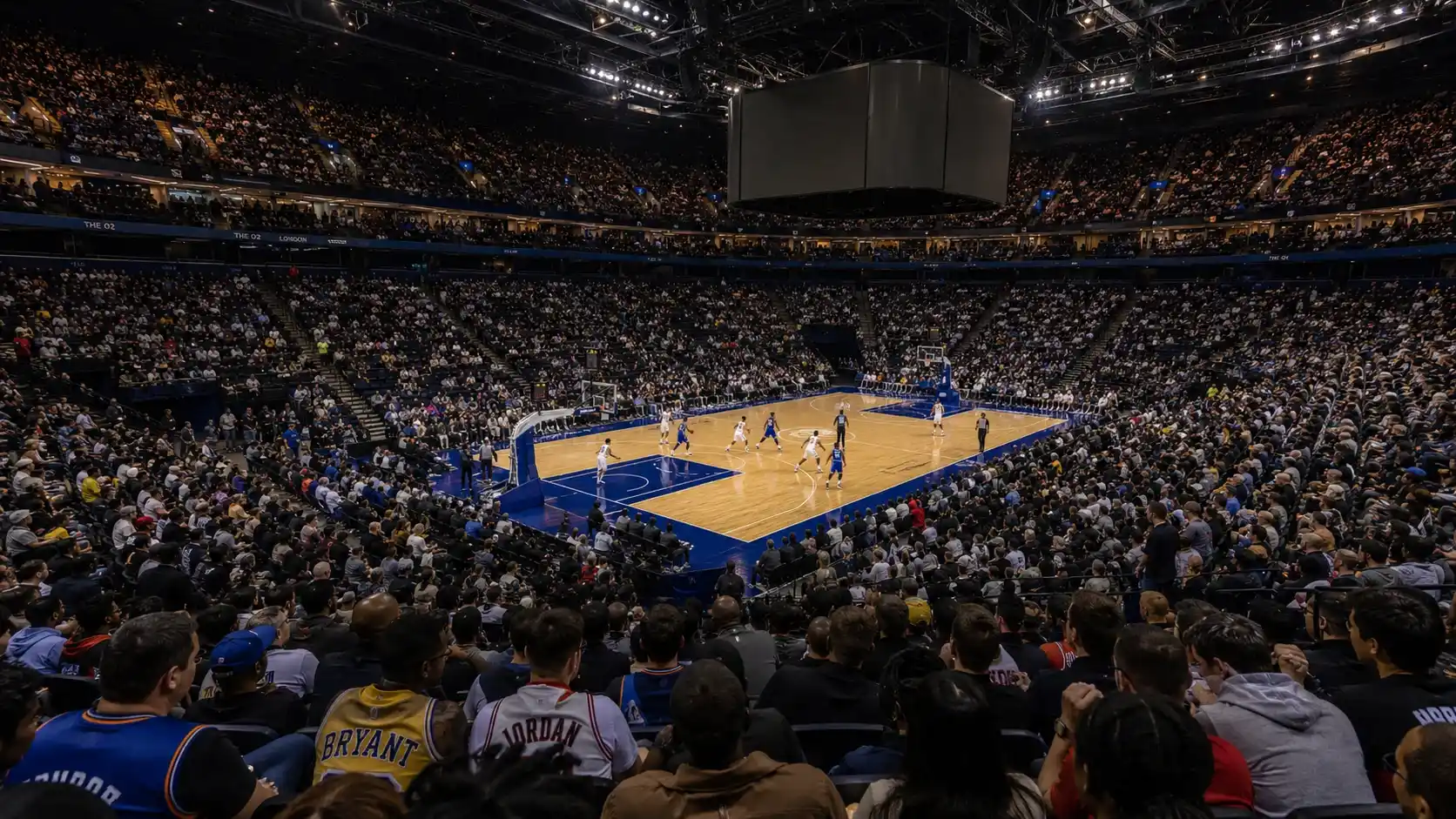
Is NBA Betting Legal in the UK, and Who Regulates It
A reader emailed me last autumn asking whether NBA betting was "technically" legal in Britain. The short answer is yes — British punters have had legal NBA wagering since the Gambling Act 2005. The question now is not "is it allowed" but "under which set of conditions". Those conditions changed three times in a single calendar year.
The UK Gambling Commission, the statutory regulator headquartered in Birmingham, licenses every operator that takes a bet from a British resident. If a sportsbook accepts your NBA slip without a UKGC remote betting licence, it is operating illegally for you, regardless of how slick its homepage looks. Chief executive Andrew Rhodes frames the role bluntly: "It's not for the Commission to be engaged in a moral debate about gambling. We're here to licence it and regulate it. Our obligation is to aim to permit gambling providing it's in line with the licencing objectives."
"Gambling in Great Britain has reached the highest GGY we have ever seen — £15.6bn. Those official statistics will tell you plenty about what is going on with gambling in Great Britain."
Andrew Rhodes — Chief Executive, UK Gambling Commission, ICE 2025 World Regulatory Briefing
Three 2025 dates reshape the framework. On 28 February 2025, the financial vulnerability check threshold dropped from £500 to £150 of net deposits over a rolling 30-day window. On 6 April 2025, the statutory gambling levy took effect, drawing between 0.1% and 1.1% of every licensed operator's gross gambling yield into a centralised research, prevention and treatment pot. And on 21 May 2025, a £2-per-spin online slot limit landed for 18-24 year olds, with £5 applying to everyone 25 and over from 9 April. The under-25 protection ethos shapes how books treat younger NBA bettors.
How to verify a UK book in thirty seconds. Scroll to the footer. The licensee name, UKGC account number and the words "licensed and regulated by the Gambling Commission" should appear, with a hyperlink that opens the Commission's public register. If any of that is missing or vague, close the tab.
One practical note. The Commission does not pre-vet odds or markets. What it polices is conduct: licensing, advertising rules, the affordability framework, anti-money-laundering, dispute resolution and self-exclusion through GAMSTOP. An offshore site offering "better odds" with a Curaçao licence is not equivalent to UKGC for a British resident.
Decimal, Fractional and Implied Probability for NBA Lines
Years ago I watched a friend argue with a Liverpool taxi driver about whether 9/4 was a better price than 3.25. They were the same number, expressed differently, and the cabbie was right. If you bet NBA in the UK, you will see both formats, and increasingly a third — implied probability percentages — quoted alongside them.
Decimal odds are the UK NBA standard at almost every major book. A line of 1.91 means your total return per £1 staked is £1.91. Fractional odds are the old British tradition: 4/5, 11/10, 6/4 — profit relative to stake. Implied probability converts an odds figure into a percentage chance the book is pricing the outcome at, and it is the only one of the three that lets you spot value at a glance.
Implied probability — the percentage chance a given price suggests for an outcome, calculated as 1 divided by the decimal odds, multiplied by 100. A line of 2.00 implies 50%. A line of 1.50 implies 66.67%.
Same NBA moneyline, three formats.
Boston Celtics to beat Atlanta Hawks at home — a typical line you would see across UK books.
- Decimal: 1.40
- Fractional: 2/5
- Implied probability: 71.43%
The book is pricing Boston as a roughly 71% favourite. A £10 stake returns £14 total (£4 profit, your £10 back).
Converting between formats — a 30-second drill.
Step 1. Take a decimal price you see on screen. Example: 2.20.
Step 2. Subtract 1 to get the fractional equivalent expressed as a decimal: 2.20 minus 1 equals 1.20. As a fraction that is 6/5.
Step 3. Calculate implied probability: 1 divided by 2.20 equals 0.4545. Multiply by 100. The book implies 45.45%.
Step 4. If your own model gives the same outcome a 50% chance, the fair decimal price is 2.00. The book at 2.20 is offering more than fair value. That gap, 50% minus 45.45%, is your edge before vig adjustment.
UK books quote 140+ NBA markets on a typical game. Every line is implicitly a percentage. The punters who consistently survive think in percentages first and let the decimal display catch up.

The NBA Bet Types UK Punters Actually Use
Open a typical NBA matchup on a major UK book and you will be looking at more than 140 individual markets per game. Bet365's NBA section runs that deep, Unibet offers 50+. For a newcomer that menu is paralysing. For an experienced bettor it is a buffet where most of the dishes are filler.
The three foundational markets — moneyline, point spread (handicap), and game total (over/under) — settle the majority of NBA volume globally. Player props, parlays, Bet Builders and live betting layer on top. Each has a distinct risk profile and hold percentage.
| Bet type | What you're betting on | Typical NBA hold | Skill curve |
|---|---|---|---|
| Moneyline | Straight winner of the game | 3-5% | Low to medium |
| Point spread (handicap) | Margin of victory vs a fixed handicap | 4-5% | Medium |
| Game total (over/under) | Combined points scored vs a number | 4-5% | Medium |
| Player prop | Individual stat output (points, PRA, threes) | 6-10% | Medium to high |
| Bet Builder / SGP | Combined legs from one fixture | 15-25%+ | High |
| Live in-play | Shifting prices during the game | 5-8% | High |
| Futures / outrights | Season-long outcomes (MVP, champion) | 20-40% | High, slow |
Notice how hold scales with complexity. A simple moneyline carries an honest vig of three to five points. Stack four correlated Bet Builder legs and the implied hold balloons.
Hold percentage — the operator's theoretical margin on a market, calculated by summing the implied probabilities of every outcome and subtracting 100%. A two-way NBA spread priced 1.91 / 1.91 has a hold of (52.36% + 52.36%) minus 100%, which is 4.72%.
Reading a UK NBA spread.
Denver Nuggets -4.5 at decimal 1.91. Implied probability: 52.36%.
To win, Denver must beat the opponent by 5 points or more. A 5-point Denver win covers. A 4-point Denver win loses the bet despite Denver winning outright.
A £20 stake returns £38.20 total — £18.20 profit, £20 stake back.
Player props are where the UK market has expanded most aggressively in 2025/26. PRA, threes made, double-double yes/no, first basket scorer — every leg has a separate price and a separate liability profile. Props also carry the highest integrity risk, which is why most operators cap stakes on individual player markets. Futures sit at the opposite end of the patience spectrum. MVP at 8.00, championship outright at 6.50 — these settle months later, and the hold is brutal. Adam Silver, the NBA Commissioner, framed the futures mindset accurately when describing NBA Europe ownership: "People who are looking for a short return should probably look elsewhere." The line applies cleanly to futures.
Going Deeper on NBA Markets
The mechanics of each market — reading a tight spread on a key number, when team totals beat the full game total, how Bet Builders and Same-Game Parlays differ once you understand the correlation maths — sit one layer deeper than a pillar can hold.
For the full taxonomy with worked examples on every bet type, I keep the deep dive in a dedicated NBA bet types breakdown for UK punters. The pillar gives you the menu. That guide hands you the recipe.
How to Choose a UK Bookmaker for the NBA
A reader once sent me a spreadsheet ranking UK books on welcome offer size. The top entry was a site I would not touch with someone else's bankroll. The criteria that should drive your choice are almost never the ones the operator's marketing department wants you to fixate on.
Four things genuinely matter, in order: licence verification, market depth on the games you actually want to bet, hold percentage on two-way markets, and settlement speed. Welcome offer terms come fifth at best.
Do
- Check the UKGC public register for the licensee name and licence number before depositing.
- Open the NBA section before signing up. Count the markets per game. Compare to two other shortlisted books.
- Calculate hold percentage on a two-way market by adding the implied probabilities of both sides. Lower is better.
- Read the financial vulnerability check policy — every UKGC licensee must publish it.
- Test the withdrawal time on a small deposit before you commit serious bankroll.
Don't
- Pick a book on the strength of its welcome offer alone.
- Bet on a site without a clearly displayed UKGC licence number.
- Accept "enhanced" odds without checking the unenhanced price on the same market elsewhere.
- Ignore void rules on late scratches — they differ between books and matter for player props.
- Sign up with an offshore site that claims a Curaçao or Anjouan licence. For a UK resident those are not equivalent to UKGC.
Market depth deserves a closer look. Bet365's UK NBA section advertises 140+ markets per game; Unibet runs around 50. The Bet Builder selection cap varies — some operators allow up to 12 legs, others cap at 6 or 8. If you live in player props or correlated parlays, that ceiling is a hard constraint.
| Operator feature | What to look for | Why it matters for NBA |
|---|---|---|
| UKGC licence verification | Footer link to public register | Legal recourse, GAMSTOP coverage, dispute resolution |
| Markets per game | 50+ minimum, ideally 100+ | Player props, alternate spreads, quarter markets |
| Bet Builder cap | 8 legs or more for correlation work | Same-game stacking, hedge construction |
| Live streaming | NBA matches included with funded account | In-play decisions require synchronous viewing |
| Cash-out terms | Partial cash-out, mid-event pricing transparency | Bet Builder hedging during late-game variance |
| Settlement speed | Final score to settled within minutes | Reuse of stake on later tip-offs the same night |
Hold percentage is the metric your gut will not naturally weigh, which is why it matters most. A 4.5% hold versus a 6% hold across a season of moderate volume is the difference between breaking even and losing your unit base.
A Closer Look at UK Bookmakers for NBA
The framework above is the pillar version. The maths — two-way hold calculations on UK NBA spreads, the exchange-versus-book comparison once you account for commission, the line-shopping routine that fits inside a weeknight slate window — sits a level deeper.
That deeper analysis sits in my hold-first comparison framework for UK NBA books. It is built around the verification process, hold maths and market depth — never around bonus rankings.
The Strategy Foundations: Pace, Schedule, Home Court
I keep a printed table on my desk that has more or less defined my NBA strategy for a decade. Team pace. Record on the second night of a back-to-back. Home win percentage. The three variables — pace, schedule and home court — are the most documented edges in NBA betting research, and they are mispriced more often than any single-game read.
B2B Public-Fade ROI Calculator
Home teams on the second night of a back-to-back, backed by 65%+ of the public, collapse to an 84–200 ATS record – and fading them returned +58% ROI in that filtered sample. Enter the spot and price to see if your fade sits inside the edge.
How this works: back-to-back data is the gold standard of NBA research because the sample is huge. Since 2005, teams on the second night of a back-to-back have gone 2,058–2,118 ATS – a 49.3% cover, essentially a coin flip. The edge only appears once you filter: home teams on a back-to-back that the public backs at 65% or more collapse to an 84–200 ATS record. That means the team the public loves covers just 29.6% of the time – so the other side, the fade, covers 70.4%. Fading that specific spot returned +58% ROI in the filtered sample. This calculator checks whether your situation matches the filter (home, on a back-to-back, public at 65%+); if it does, it applies the 70.4% historical cover rate for the fade. Value = (cover rate × (odds − 1)) − (miss rate × 1) per £1. The break-even line is what a symmetrical 1.91 price needs: 52.4%. At 70.4% historical cover, the edge over break-even is large – that gap is the documented ROI. Two honest caveats. First, this is a historical base rate over a filtered sample, not a guarantee for one game; the cover rate on any single fade is either 0% or 100%. Second, the filter is strict for a reason – the moment the situation isn't a home B2B favourite backed by heavy public money, you're back to the 49.3% coin flip with no edge, and the calculator will say so. The public percentage is the trigger, not decoration: below 65% the historical record doesn't apply. Not financial advice. 18+ – GAMSTOP and BeGambleAware are protection routes; National Gambling Helpline 0808 8020 133.
Start with pace. The league average sat at roughly 99.4 possessions per 48 minutes in 2024/25. Boston, a deliberate half-court team, ran at 96.45. Other teams pushed past 103. When a 96-possession team plays a 103-possession team, the resulting game tends to anchor toward the slower side. That shifts the fair total by 4 to 6 points, and the market is consistently slow to price it on lesser-watched matchups.
Pace as a totals lever.
Step 1. Identify the two teams' pace figures. Suppose 100.5 and 96.0.
Step 2. Average them: 98.25 possessions.
Step 3. Multiply by the league's average offensive rating per possession — roughly 1.16 points. 98.25 multiplied by 1.16 gives 113.97 per team, or about 227.9 combined.
Step 4. Compare to the book's posted total. If the line is 233.5, the market is pricing roughly 2.4 possessions more than the team averages suggest. That gap is your raw edge before adjusting for injuries and rest.
Home court is the second pillar, and the most surprising one for newer punters. The league average home win percentage in 2024/25 was 54.4%, with a brutal range — Oklahoma City won 85.4% of their home games, Washington won 20.0%. For 43 years the league sat closer to 60%. Sparkle Technologies, working from a 43-season dataset, found a correlation of minus 0.88 between three-point attempt volume and home court win percentage. Teams went from 2.4 threes attempted per game in 1983 to 37.6 in 2025. Variance from beyond the arc washes out the crowd's influence on the marginal possession.
In the NBA Finals specifically, the team with home-court advantage has won 71.79% of the time historically — markedly higher than the regular-season average. Seven games, ten days of travel and the highest-leverage possessions tip the scale back toward the host venue.
The third pillar is schedule. Back-to-back data is the gold standard of NBA betting research because the sample size is huge. Since 2005, teams on the second night of a back-to-back have an ATS record of 2,058 to 2,118 — a 49.3% win rate. Marginal on its own. The edge emerges when you filter further: home teams on a back-to-back when the public is on them at 65% or more collapse to an 84-200 ATS record. Fading the public on home back-to-back teams generated a 58% return on investment in that filtered sample.
Late-game pace collapse is the underrated cousin. Research by Wang and colleagues across 2,295 NBA games found that 19% of games are within 10 points entering the fourth quarter, and in those tight games pace drops to 90-100 possessions per 48-minute equivalent. Shooting efficiency falls in parallel — García and colleagues documented a Cohen's d effect size of minus 1.27 between first-quarter and fourth-quarter shooting. Live totals on close games go Under far more often than the in-play market implies in the first minute of the fourth quarter.

Where the Real Edges Hide
Pace, schedule and home court are the foundations. The cluster article carries the rest of the toolkit: closing line value tracking, the precise public-fade thresholds on back-to-back home favourites, injury report workflow, and how to size your units to edge rather than to confidence.
For the working strategy manual, see the NBA betting strategy guide for UK bettors. The pillar shows you the variables. That article shows you the routine.
Integrity, Referees and Why That Matters for Your Bet
In 2025 Sportradar flagged 233 suspicious basketball matches globally — the second-highest tally across all sports, behind only football's 618. That is operational evidence that the prop-bet ecosystem in particular is under intense scrutiny.
The view from the league office is unambiguous. NBA Commissioner Adam Silver, on the ongoing investigations: "If my choice were legalized sports betting vs. illegal sports betting, I still think a legalized structure is better. What we're seeing now in some of the investigations you're referencing is operational data, which causes in many cases, betting companies or independent agencies who are overseeing this betting activity to raise flags." The same regulated infrastructure that produces the betting market also produces the surveillance trail.
"The deterrent isn't that it can't be done. The deterrent is now more eyes on it. There's people looking. So as a referee or a player, you've got a lot more fear or caution, because you know they're looking."
Adam Bjorn — COO, Plannatech (NBA integrity partner)
The referee question changes how you think about close-game pricing. A 2025 study by Belasen, Belasen and Olbrecht — the most rigorous referee-bias analysis since the Donaghy era — found that in the last two minutes of close games, referees made 23% fewer incorrect calls against visiting underdogs and 42% fewer against home underdogs. The bias runs in favour of underdogs in tight late-game spots. The authors put it directly: "Unmitigated incorrect calls may affect the fairness and integrity of game outcomes as well as result in financial consequences for gaming operators and sports bettors."
The Jontay Porter case in plain English. An NBA player was banned for life in 2024 after coordinating with bettors to underperform in specific prop markets, triggering the FBI's involvement and reshaping how the league monitors player props. The case sits behind every UK book's tighter stake limits on individual player markets in 2025/26.
The takeaway is not paranoia. Integrity is now an embedded variable in NBA pricing, just like pace or rest. Books adjust limits on prop markets when a player has unusual buzz. The grid that watches NBA wagering, on balance, makes the markets you participate in more honest, not less.
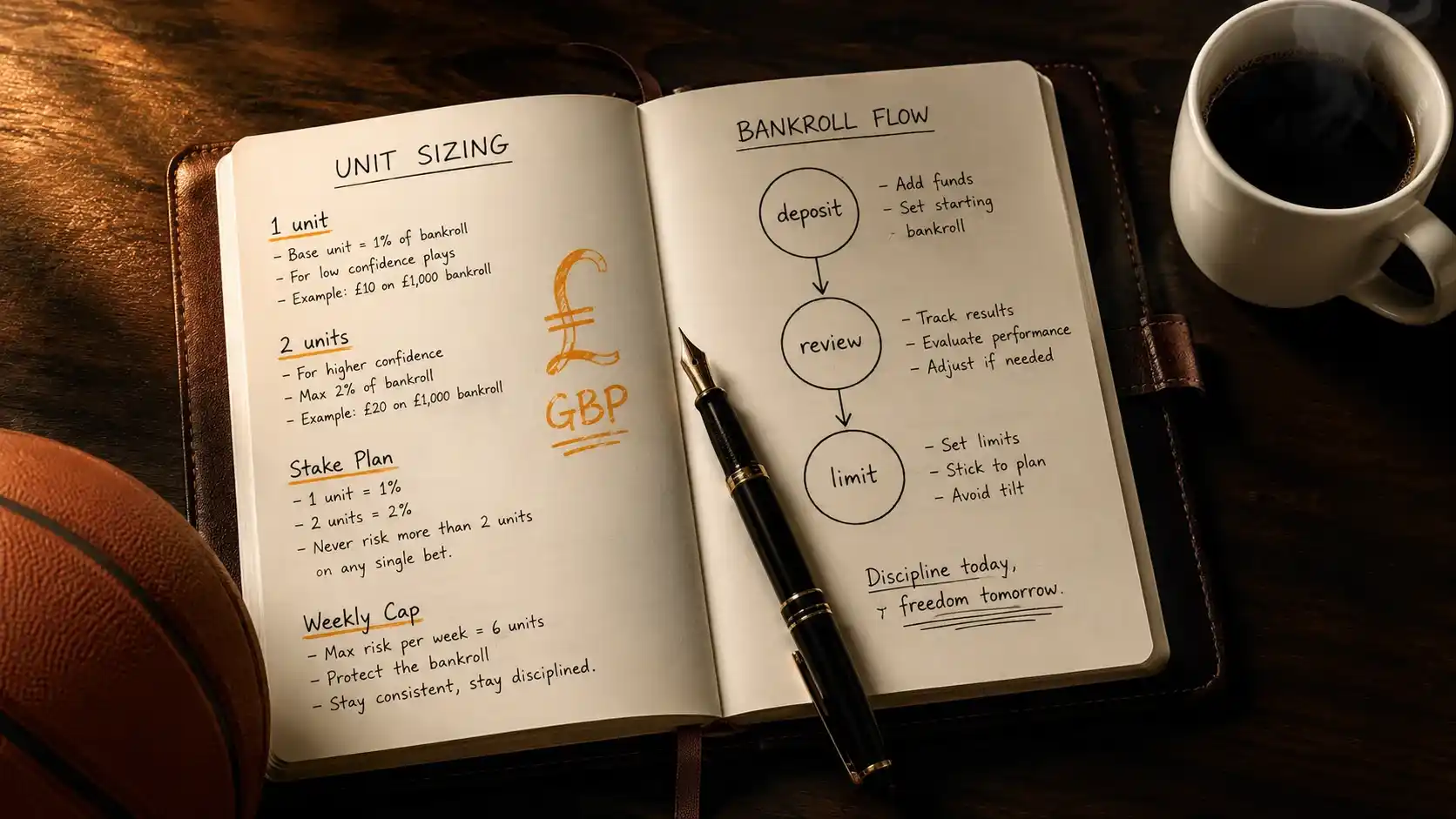
Bankroll, Unit Sizing and the £150 Threshold
The £150 figure is not a regulatory abstraction. It is a hard line in the operational reality of every UK NBA bettor since 28 February 2025. Once your net deposits cross £150 across a rolling 30-day window, a UKGC-licensed book is required to perform a financial vulnerability check. That can mean a documentation request — bank statements, payslip, source-of-funds confirmation. It is mandated under SRCP 3.4.4(6), and refusing to comply will pause your account. Your bankroll structure has to account for it.
The PGSI data frames why the threshold exists. Around 2.7% of UK adults are classified as problem gamblers, with a further 3.1% at moderate risk and 8.8% at low risk. Among men the rate is 6%, more than double the 2.8% figure for women. Treat the £150 trigger as a planning input, not a barrier.
Unit sizing on a £600 NBA bankroll.
Step 1. Define your unit base. A standard 1-3% per bet on a £600 bankroll gives a unit of £6 to £18. I keep mine at 1% for spread plays and 2% for live signals where the edge is sharper.
Step 2. Plan deposit cadence around the £150 monthly threshold. If you fund the bankroll in two deposits of £75, you stay under the check trigger across a rolling 30-day window.
Step 3. Track every bet by stake percentage, not by money won or lost.
Step 4. When the bankroll grows or shrinks by 25%, recalculate the unit. A static unit on a moving bankroll is the most common cause of bust.
What a financial check actually involves. The book asks for proof of disposable income relative to your deposit level. Common documents: bank statements covering 3 months, payslip or self-assessment, screenshot of investment or savings balance. It is not a credit check and does not affect your credit score. Comply or pause.
Do
- Treat unit base as a percentage of bankroll, not a fixed pound figure.
- Keep a public spreadsheet of every bet, stake, price and result.
- Recalculate unit size after every 25% bankroll move.
- Account for the £150 rolling threshold when planning monthly deposits.
- Use deposit limits as a structural commitment, not a punishment.
Don't
- Chase losses by doubling unit size after a losing run.
- Round up to "neat" £20 stakes because they feel tidier than the 1.7% your spreadsheet actually says.
- Conflate deposit volume with skill. The two are unrelated.
- Withdraw between bets to "lock in" wins — it distorts your bankroll tracking.
- Borrow funds to keep betting after a losing slate.
The Full UK Regulation Picture
There is a layer below the £150 threshold and the unit-sizing logic: the statutory levy maths, GAMSTOP coverage rules, advertising restrictions on NBA promos, the ADR escalation path, and the under-25 protection framework.
The complete regulatory picture lives in the UK regulation and safe NBA play guide. It is the article I send to readers who want to understand the rule set rather than just operate inside it.
Watching the NBA from the UK While You Bet
The structural problem of NBA betting for a British punter is that most games tip off when sensible people are asleep. A 7:30 p.m. Eastern start lands at half past midnight in London. A 10:30 p.m. Eastern start is half past three. Weekend afternoon NBA — Saturday Showcase, Sunday national windows — is the most civilised slot at around 8 or 9 p.m. UK time.
The broadcaster landscape has reshaped itself around UK demand. Sky Sports signed an 11-year agreement with the NBA starting in 2025/26, carrying 100 regular-season games per year. Prime Video carries 86 regular-season games and holds exclusive Finals rights in six of the eleven contracted seasons. NBA League Pass viewing in Europe grew 37% year-on-year in 2025/26.
Practical tip-off windows for a UK punter.
- Saturday/Sunday early window: 8 p.m. to 10 p.m. UK time. Most accessible slot.
- Weeknight standard window: 12:30 a.m. to 3 a.m. UK time. The bulk of NBA volume.
- West Coast late window: 3 a.m. to 5 a.m. UK time. Bet the line and sleep. Settle on the iPad over breakfast.
- Christmas Day, MLK Day, In-Season Tournament Knockout: special slots, often 5 p.m. to 10 p.m. UK time.
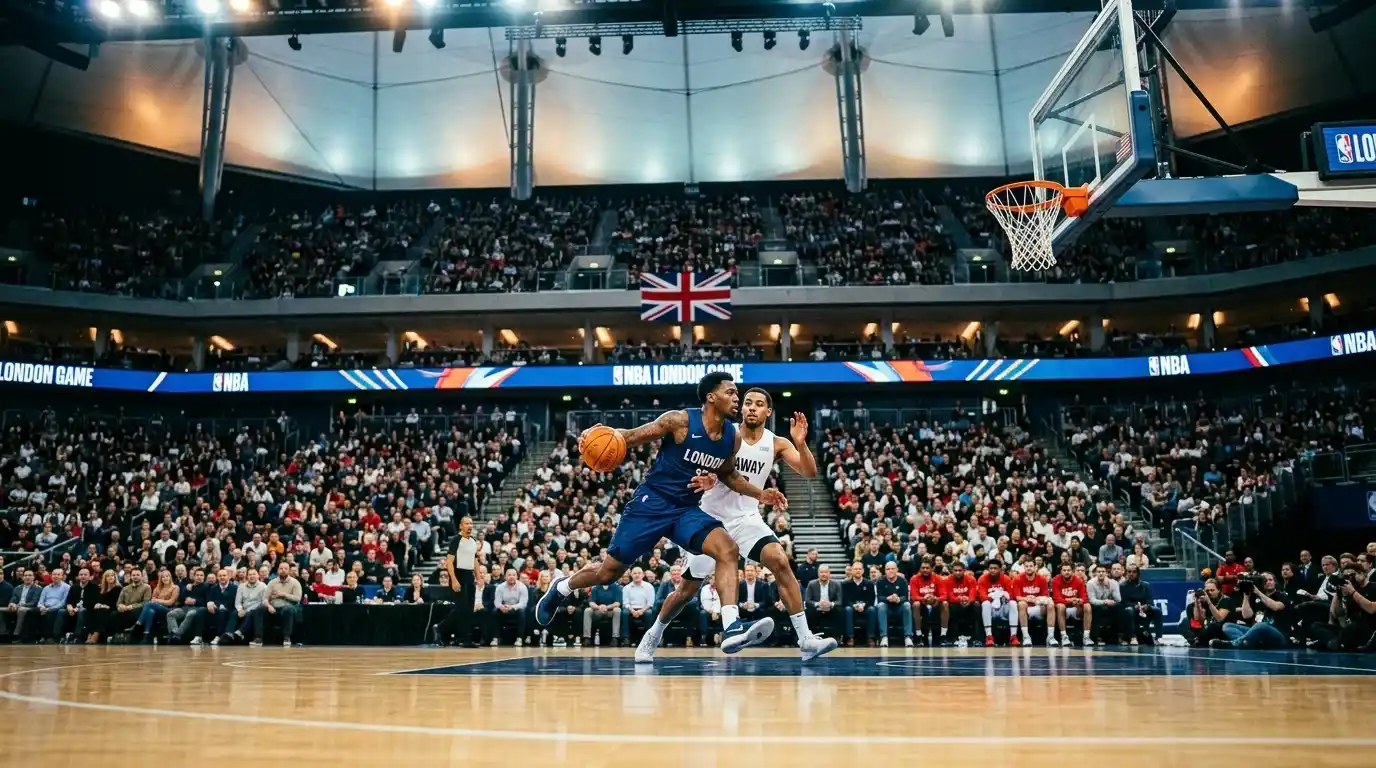
The 2026 NBA London Game — Orlando Magic versus Memphis Grizzlies at the O2 Arena — sold out at 18,000-plus and became the most watched NBA Global Game ever in the UK, 90% above the London Game 2019 audience.
If you bet through the late window regularly, sleep discipline is part of bankroll discipline. A 3 a.m. live decision made on three hours of sleep is statistically worse than the same decision at 8 p.m. Pre-match locks before tip-off are nearly always better expected value than chasing a price at 4 a.m.
NBA London Games and the Coming NBA Europe
Standing in the O2 Arena for the 2026 London Game, with Paolo Banchero warming up twenty feet from the front row of an 18,000-strong crowd, I had the uneasy sense I was watching a turning point. The audience figure was 90% higher than the 2019 London Game, and the concourse conversation was no longer "isn't it cool the NBA came here" — it was "when does this become permanent".
The pipeline is public. Six regular-season NBA games will be played in Europe across 2026 to 2028: London and Berlin in 2026, Manchester and Paris in 2027, Berlin and Paris in 2028. Each opens a discrete betting market, and the books learned from 2026 that UK demand on these fixtures is significantly higher than a comparable regular-season slot.
"We see enormous opportunity for basketball in Europe. Despite that momentum, there is a significant gap between the level of interest in basketball and the sport's untapped potential for fans, players, teams, cities, and overall commercial development across Europe."
Leah MacNab — Senior Vice President, Head of International Strategy & Operations, NBA
NBA Europe is the larger story. The proposed league, planned in partnership with FIBA, targets a launch around October 2027 with 14 to 16 teams. London and Manchester are listed as candidate host cities. Entry fees for new clubs are estimated between $500 million and $1 billion. The talent already exists: in 2025/26 the league fielded 71 European players, including Antetokounmpo, Jokic, Doncic and Wembanyama.
What this means for UK betting markets. A new NBA-affiliated European league with London as a likely host city will generate its own pre-match markets, futures and probably player props, almost certainly carried by every major UK book. The market will be thin and inefficient in its first season — exactly the condition that rewards bettors who do the structural homework early.
Adam Silver has been candid about the difficulty of delivering it, describing the European league as "an enormous undertaking, which is why we've been moving one step at a time and being very careful and cautious and making sure we're covering all our bases." The 2027 launch date is a target, not a guarantee. Plan for the opportunity, but do not stake against the calendar.
The NBA Europe Betting Outlook for UK Punters
The bet-by-bet implications of the London Game and the 2027 launch — how the books will price inaugural London-based fixtures, what early NBA Europe futures markets will look like, how BBL audience overlap shapes liability for UK operators — sit one rung deeper.
The full breakdown is in my analysis of the NBA Europe and London Game betting outlook for UK punters. The article to read before the next European fixture goes on the board.
Eight Mistakes UK NBA Bettors Keep Making
I have reviewed enough punter spreadsheets to spot the same eight errors on a loop. They come from one of three places: an inherited football-betting instinct that does not apply to the NBA, an American-style guide that ignores UK regulation, or the slow erosion of discipline that comes from watching games at 3 a.m. Survey work backs the third one up — 86% of UK punters aged 18-24 say they see betting as a form of investment. That framing slips into bankroll decisions in ways that hurt.
Do
- Read the actual game flow — pace, rest, lineup — before placing the bet.
- Track closing line value, not win-loss percentage.
- Treat back-to-back spots as the most documented edge in NBA betting research.
- Bet pre-match when you can; chase live prices only when you have a specific structural read.
- Use deposit limits as a structural commitment, set them before you tilt.
Don't
- Stake based on team narrative. "Lakers are due" is not a thesis.
- Combine more than four legs in a Bet Builder without modelling the implied hold.
- Ignore home back-to-back ATS records — the 84-200 record on heavily-backed home B2B favourites is your warning.
- Bet the early game on a slate just because the late games will keep you up. Game selection is a discipline.
- Confuse a profitable run with edge. Six bets is noise, six hundred is signal.
The most expensive mistake is chasing late-night live prices. The 4 a.m. live market is the single most profitable hour for a UK book — the bettors awake then have self-selected into insomniacs, jet-lagged travellers, or people who have already lost the early games and want to claw back.
Before you click "place bet"
- Is the stake within 1-3% of my current bankroll?
- Have I checked the price at one other UK book?
- Do I have a specific reason — pace, schedule, lineup, value — for this bet?
- Am I awake enough to make this decision sober?
- Would I make this bet tomorrow morning if it were still available?
The eight mistakes I see most often: parlay stacking with no correlation logic, ignoring the pace of the slower team in a totals bet, backing the public side of a B2B home favourite, chasing live in the final minutes of a blowout, betting MVP futures in February when the market has tightened, staking based on "due" narratives, doubling unit size after a bad slate, and depositing past £150 without planning for the affordability check.
Your Pre-Bet Checklist Before Each NBA Slate
Routine is the unsexy heart of NBA betting. The strongest punters I know run the same checklist every slate, in the same order. The discipline is the edge — the alternative is decision fatigue at 1 a.m., precisely when the worst bets get placed.
The slate-by-slate routine
- Check the NBA Injury Report. Status tags update as late as 30 minutes pre-tip; do not assume the morning version still holds.
- Identify back-to-back teams on tonight's slate. Flag the home team on B2B with public over 60%.
- Calculate pace differentials for each fixture you are considering. If a slow team is hosting a fast team, the Under is the default lean.
- Shop the line at two or three UK books before locking. A half-point difference on a key number changes the cover probability by 2-3%.
- Confirm your stake is within the 1-3% unit base. Round down, not up, when in doubt.
- Note your current rolling 30-day deposit total. Stay aware of the £150 threshold.
- If you bet four-plus fixtures on a slate, you are probably overbetting. Cut to your two highest-confidence reads.
- Set a hard time at which you will stop placing new bets, regardless of live opportunities.
A repeatable pre-bet routine compounds across a season the way a strategy edge does. The single best decision is to stake within 1-3% of bankroll, on two or three high-confidence reads per slate, after checking injuries and pace, at two or three UK books. Most bettors fail one of those steps on most slates. The ones who do not, win.
Responsible NBA Betting: Tools, Limits, Help
This section is not a disclaimer pasted on for compliance. The numbers that frame responsible play in the UK deserve attention on their own terms. UKRI estimates the annual fiscal cost of gambling-related harm in Britain at £1.4 billion. The Gambling Survey for Great Britain puts the problem gambling rate at 2.7% of adults, with another 3.1% at moderate risk. Public opinion has shifted accordingly — 65% of UK adults agree gambling advertising increases the risk of harm, and 78% support stricter restrictions.
"Our daily lives are inundated with gambling advertising and marketing. It is normalising what is a risky activity which can have a huge negative effect on people's lives, even children."
Zoë Osmond — Chief Executive, GambleAware
The tools available are practical and free. Deposit limits, loss limits and session time-outs are mandated features on every UKGC-licensed operator's account settings, and they can be set tighter than the regulatory minimums. GAMSTOP is the national self-exclusion scheme — registering blocks you across every UKGC-licensed gambling site for six months, one year, or five years. Free helplines run by GambleAware and Gordon Moody offer counselling and structured treatment routes.
Setting a deposit limit before tip-off. Every UK book has the same workflow: account settings, responsible gambling, deposit limit. Choose daily, weekly or monthly. Increasing the limit involves a cooling-off period — typically 24 hours — designed to interrupt impulse decisions. Decreasing it takes effect instantly. Set the limit when you are calm, not after a losing slate.
The statutory levy that took effect in April 2025 is changing the funding mechanics behind these services. In its first year the levy raised approximately £120 million — above the DCMS forecast of £90 to £100 million — funnelled into UKRI, the Office for Health Improvement and Disparities, and the NHS. Bet within your means, set limits before you start, and treat the £150 financial vulnerability check as the system working as designed.
FAQ: UK NBA Betting Help
The questions below are the ones that land in my inbox most often from British NBA punters.
Is NBA betting legal in the UK?
Yes. NBA betting has been legal under the Gambling Act 2005, and is regulated by the UK Gambling Commission. Any sportsbook operating in Britain must hold a UKGC remote betting licence, and every NBA market on a licensed site is fully lawful for British residents aged 18 or over. As of 28 February 2025, financial vulnerability checks are required at £150 net deposits over a rolling 30-day window — a regulatory addition, not a restriction on legality.
What is the best NBA bet type for beginners?
The point spread (handicap) in decimal odds at around 1.91 is the cleanest starting point. Hold percentages are low (4-5%), the price is symmetrical on both sides, and the bet rewards margin opinion rather than just picking a winner. Moneyline is simpler conceptually but heavily favours juicing the bigger favourite. Avoid Bet Builders and multi-leg parlays until you can calculate the implied hold on a single market.
How do NBA point spreads and handicaps work in decimal odds?
The handicap is a points adjustment applied to one team. If Boston are listed at -4.5 at decimal odds of 1.91, you are betting that Boston will win by 5 or more points. If they win by 4 or fewer, or lose outright, the bet loses. The half-point eliminates the possibility of a tie (push). Decimal 1.91 means a £10 stake returns £19.10 total — £9.10 profit on top of your stake.
Do NBA bets include overtime?
For game-level markets — moneyline, point spread, game total — yes, overtime counts toward settlement at virtually every UK book. For quarter and half markets, no — those settle on the period specified. For player props, the answer varies by operator and by market. Always read the void rules in the book's terms before placing prop bets, particularly on points and PRA markets where overtime can push an Under into the Over after the fact.
Why are NBA games so late for UK bettors, and how do you handle the time zone?
Eastern Time tip-offs of 7:30 p.m. translate to half past midnight UK time. Western Conference games tipping at 10:30 p.m. Eastern start at half past three in the morning UK time. The practical workaround is to bet pre-match before tip-off, then either sleep through and settle in the morning, or watch only the early window (weekends are far easier than weeknights). Late-night live betting is one of the most documented loss patterns for UK punters — the books price the late hour accordingly.
How much should I stake on an NBA bet?
The benchmark across professional bankroll management literature is 1-3% of your current bankroll per bet. On a £500 bankroll, that is £5 to £15 per stake. Recalculate the unit after every 25% move in your bankroll, up or down. Static stakes on a moving bankroll is the most common cause of going broke. Account for the £150 rolling 30-day financial vulnerability threshold when planning monthly deposit cadence.
Where can I watch NBA games live in the UK while betting?
Sky Sports holds an 11-year deal with the NBA starting in 2025/26, carrying 100 regular-season games per year. Prime Video carries 86 regular-season games plus exclusive Finals rights in six of the eleven contracted seasons. NBA League Pass is the comprehensive option for fans who want every game live. Most major UK books also stream NBA games to funded accounts, though feed quality and latency vary. Check the stream lag before trusting it for live betting decisions.
Closing Notes from the Analyst's Desk
I started this guide with a half-built Bet Builder at half past midnight in March, and I want to end it with a different image. Three monitors, a spreadsheet of every bet I have placed this season, a printed page of NBA team paces, and a half-cold cup of coffee. The work that produced those tools — the modelling, the line-shopping, the discipline of tracking closing line value rather than win-loss — is the actual edge in UK NBA betting. Not a tip service. Not a welcome offer.
Adam Silver said something earlier in 2025 I have been thinking about: "If my choice were legalized sports betting vs. illegal sports betting, I still think a legalized structure is better." The implication for a UK NBA bettor in 2026 is this — you are operating inside a system deliberately constructed to be honest. The UKGC's affordability checks, the statutory levy, the GAMSTOP infrastructure, the integrity surveillance grid that flagged 233 suspicious basketball matches in 2025 — all of it is the architecture of a market that can be trusted to settle your bet as priced. That trust is the foundation on which any edge you find sits.
Pace, schedule and home court are the most documented edges in NBA betting. Decimal odds, a 1-3% unit base and an awareness of the £150 financial check are the operational floor. The rest is discipline — and discipline compounds across a season the way edge does. The British NBA market in 2025/26 is bigger, younger and tighter-regulated than ever. For the patient analyst, it is the most interesting it has ever been.
