
NBA Futures for UK Bettors: MVP, Championship and Conference Markets That Reward Patience
 Available in US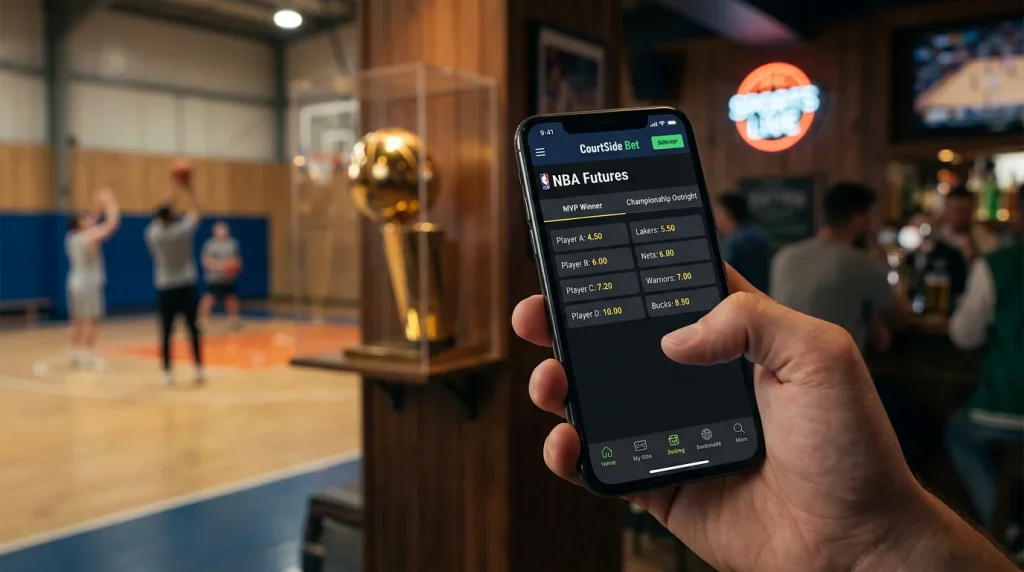
The Market That Sleeps Until It Doesn’t
I placed a Nikola Jokic MVP futures ticket in November 2022 at 6.50 decimal. The bet sat dormant for four months while every other market on my account moved. In April 2023 it cashed at 6.50, paying out an amount that no single-game bet in the same season had come close to producing. That’s the futures market in one sentence: long stretches of nothing, occasional rewards that justify the patience.
NBA futures markets are where the smart money parks long-term positions on outcomes that resolve months after the bet is placed. MVP at the start of training camp. Championship at the All-Star break. Conference winners at the trade deadline. Each of these markets has its own pricing dynamics, its own peak-value windows, and its own brand of trap. The NBA All-Star 2026 broadcast pulled a 138 million unique-viewer reach – the highest since 2011, an 87% year-on-year jump – and the volume of futures betting around the event reflects that wider audience growth.
What I want to walk through is the structure of the futures market: how MVP pricing actually moves, when championship odds offer their best value, where conference and division markets sit in the operator’s mind, and the holding-versus-hedging decision that determines whether your dormant ticket pays out at full price or gets crystallised for a fraction. The market rewards patience. It punishes impatience even harder.
See also NBA MVP betting narrative bias for deeper analysis.
The Shape of the MVP Market
NBA MVP futures open at UK books in early October, when training camp finishes and the regular season tips off. The opening field typically prices 8-12 candidates between 4.00 and 15.00 decimal, with a long tail of names at 25.00 to 200.00. The opening prices reflect roughly equal parts statistical projection, narrative momentum from the previous season, and operator copy-paste from US sportsbooks.
The market moves on three things: regular-season performance, narrative cycles in mainstream media, and team success. A player putting up 32 points and 11 assists on a team winning 60 games is the prototype. A player putting up 35 and 9 on a team winning 38 games rarely wins the award, regardless of individual statistics. The MVP is a team-success-weighted individual award, and the market has priced that bias for decades.
The biggest price moves happen in three windows. First, late November – when early-season standings have stabilised and the operators recalibrate. Second, January – when the trade deadline approaches and team contention windows clarify. Third, March – when voting narratives crystallise and the field reduces to two or three serious candidates. After mid-March, the favourite is usually below 1.50 decimal and the value has evaporated.
The value play in MVP futures: pre-season tickets on candidates priced 8.00 to 20.00 who fit the profile (mid-prime, high-volume star, on a contender that’s overlooked at opening). The variance is enormous – you’ll lose 8 out of 10 of these tickets – but the survivors pay enough to make the long-run EV positive for sharp pickers. The trap: chasing the favourite in February at 1.80 decimal because “they’re going to win,” when the implied probability already exceeds 55% and the market has fully priced the narrative.
Championship Windows and the Trade Deadline Pivot
NBA Championship futures open with the wider sport in October, with 5-7 teams priced between 3.50 and 12.00 and a long tail running to 500.00 for bottom-feeders. The market is the deepest futures product UK books carry, with depth of 30+ teams priced at every operator.
Championship odds move on three structural events. The first is roster construction – the offseason and early-season trades that define a team’s true ceiling. The second is injury news on stars. The third is the February trade deadline, which often reshapes contention more than any pre-season move. A team that was 8.00 to win the title in October can drop to 4.50 in early February if they add a star at the deadline.
The peak-value windows for championship futures: pre-season on overlooked contenders, mid-December when the early-season favourites have shown vulnerability (and prices on the second tier improve), and immediately after the trade deadline when underrated additions haven’t fully been priced. The trap windows: All-Star break (everyone’s awake, prices have settled), playoff seeding clarity in late March (prices spike for top seeds), and during a winning streak (the public chases short prices).
My rule on championship futures: never bet a team at less than 6.00 decimal unless they’ve shown me something the market hasn’t priced. The variance is too high in a sport where the eventual champion has lost 25-35 regular-season games and could lose 4 playoff series. Hedging out a 4.00 ticket in May feels safe; the maths usually says hold. I’ll take a 12.00 to 25.00 ticket on a contender I genuinely rate and accept that the most likely outcome is the ticket dies in the second round.
Conference and Division Edges Worth Watching
Conference winners (East or West) and division winners are smaller-market futures with tighter pricing because the field is narrower. The Eastern Conference winner futures typically price 6-8 teams between 3.00 and 12.00, with the long tail running to 100.00. The Western Conference is usually deeper, with 8-10 teams between 3.50 and 15.00 reflecting the typical strength imbalance.
The NBA’s 2025/26 roster carried 71 European players, including the league’s top tier – Antetokounmpo (Greece), Jokic (Serbia), Doncic (Slovenia), Wembanyama (France). That international depth concentrates star quality unevenly across conferences, and the futures market has slowly adjusted to reflect it. The Eastern Conference market has been more open in recent seasons (multiple credible contenders at 5-8 odds) while the Western Conference has often had a clear favourite at 3.00 or shorter.
Where conference futures offer value: secondary contenders in a conference with a dominant favourite. If the West has a 2.50 favourite, the 5.50 second team often offers better risk-adjusted value than backing the favourite. The favourite’s implied probability (40%) requires consistent execution; the second-tier team only needs to upset one series to deliver a 5.50 payout. Variance favours the long shot when the field is concentrated.
Division winner futures are the thinnest market in NBA futures and often the softest priced. A division contains four to five teams; the favourite is usually obvious; the variance comes from injuries and trade-deadline movement. UK books often carry these markets without aggressively shopping for sharp action, which means the prices can lag the championship market by days or weeks. Division winner second-favourites at 4.00-6.00 occasionally offer better value than the conference market they sit inside.
Niche Futures and the Long Tail
UK books carry futures beyond MVP, championship, and conference. Rookie of the Year, Defensive Player of the Year, Sixth Man of the Year, Most Improved, Coach of the Year. Each one has its own pricing dynamics and its own bias – Rookie of the Year is overwhelmingly statistical (high-usage rookies on bad teams win), Defensive Player of the Year leans toward elite shot-blockers, Most Improved correlates with second-year players who get a usage bump.
The biggest niche futures opportunity: pre-season Rookie of the Year tickets on high-pick rookies who land in high-usage situations. The market opens with the top two or three names priced 2.50-4.50, but the historic data shows the eventual winner is often a top-five pick who wasn’t the consensus first overall. Tickets at 8.00-15.00 on second-tier rookies in high-usage spots produce real EV when the pre-season favourite hits a wall.
The trap: niche futures where the operator’s modelling is weak and the hold is therefore wide. The total field implied probabilities on some niche markets sum to 130-140%, meaning the operator is taking 30-40% hold across the entire market. That’s brutal – you can’t beat a market with a 30% hold across the long run. Stick to MVP and championship futures where the implied probabilities typically sum to 110-120% (10-20% hold), reflecting a market the operator has actually priced rather than copy-pasted from a feed.
Win totals on individual teams are another adjacent market – over/under bets on a team’s regular-season win count. The product is technically a futures market, but it resolves at the end of the regular season rather than after the playoffs. Some UK operators price win totals aggressively; others lazily. The win-total market on under-rated rebuilds or over-rated veterans has been one of my consistent edges over recent seasons.
Holding the Ticket Versus Hedging the Position
The hardest decision in futures betting is what to do when your ticket reaches the playoffs and is suddenly worth real money. A pre-season Lakers championship ticket at 18.00 decimal on a £50 stake, with the Lakers now in the Western Conference Finals at 2.40 decimal, has a current cash-out value of around £350 (operator-margin-adjusted) and a potential full payout of £900.
The hedge logic: bet against the Lakers winning the title at the current 2.40 decimal price, sized to lock in a guaranteed profit regardless of outcome. The hedge stake to lock in equal profit on both outcomes: roughly £270-£300 on the field at 2.40, leaving you with a guaranteed return between £400-£500 depending on the exact prices and the operator’s cash-out margin.
The hold logic: leave the ticket. The Lakers’ implied probability at 2.40 is 41.7%. If you genuinely think they’re a 50% chance to win the title, the hold is +EV. If you genuinely think they’re a 35% chance, the hedge is +EV. The decision depends entirely on your honest probability estimate versus the current market.
What I do in practice: partial hedge. Lock in 50-60% of stake-equivalent on the hedge side, leaving the original ticket to run with reduced variance. The full payout if the original wins is still significant, but the downside is capped. The pure-hold position is the highest-EV play if your estimate beats the market, but the variance is brutal – losing a series 4-3 after holding a ticket all season is a uniquely painful experience that very few punters handle well.
One more thing: hedging on the operator’s cash-out button versus hedging by placing a counter-bet at current prices. Operator cash-out builds in a 5-12% margin on top of the implied position. Manual hedging via a counter-bet at fair market prices is usually 3-5% cheaper. The maths is identical, but the operator pays you less on the cash-out button than the open market would. For UK punters with multiple accounts, the manual hedge route is materially better value. If you want to extend the futures thinking into how narrative bias shapes specific markets like MVP voting, my deeper writeup on narrative bias in NBA MVP betting goes into the voting mechanics and value windows.
Where the Long Wait Pays Off
Futures reward two things: patience and selectivity. Patience to hold tickets through dormant stretches without trading them away on operator pressure. Selectivity to avoid the easy traps – short favourites in February, fashionable second-tier contenders in November, niche markets with brutal holds. The structure rewards the bettor who understands that a dormant ticket retains its full payout potential and that hedging is a tool for risk management, not a substitute for original analysis. The market sleeps. So should you, until the moments that genuinely matter – opening week, the trade deadline, and the playoff bracket reveal – when futures swing harder than any other product on the UK betting card.
See also nba betting help for the complete NBA betting guide.
Pre-season - opening week in October - offers the best risk-adjusted value on candidates priced 8.00 to 20.00 who fit the MVP profile (mid-prime star, high-volume, on a credible contender). The variance is enormous, but the survivors pay enough to make sharp picking long-run profitable. By the All-Star break, the favourite is usually below 2.50 and the value has evaporated. A secondary window opens in late November if a candidate has stumbled and the price has drifted, but the cleanest entry is opening week before regular-season narratives have crystallised. For team-based futures (championship, conference, division), trades don't void the bet - your ticket on Lakers to win the title still runs regardless of which players are on the roster. For player-based futures (MVP, Rookie of the Year, individual awards), eligibility usually requires the player to remain in the NBA - trades within the league don't void the bet, but a release or international transfer can. For futures tied to specific team success with a specific player (some 'first team to do X' markets), the bet may be voided if the player moves. The specific terms vary by operator and bet type. Read the small print before clicking on player-specific long-shot futures.Frequently Asked Questions
When is the best time to place an NBA MVP future bet in the UK?
Are NBA futures voided if a player is traded mid-season?
