
NBA Cup Betting in the UK: Group Play, Knockouts and the Mid-Season Format Edge
 Available in US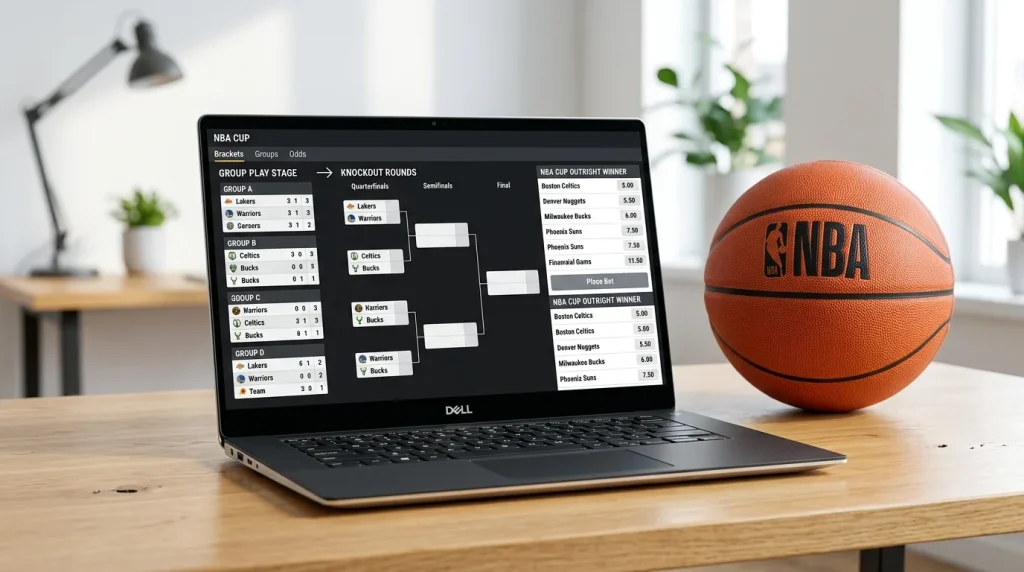
The Format That Took Two Seasons to Click
When the NBA Cup launched in 2023, I treated it like extra regular-season games – bet the same way, expect the same patterns. Two seasons later I had figured out, expensively, that the format itself creates pricing inefficiencies the books are still pricing for and the punters are still misreading. By the 2024-25 Cup, the angles were visible. By the 2025-26 Cup, the angles are tighter but still profitable for the disciplined UK punter who has done the homework.
The 2025 NBA Cup group play attracted over 40 million US viewers, up 90 percent year-on-year. The format works as entertainment. It also works as a betting opportunity because the incentive structure differs from the regular season in ways that create predictable line inefficiencies – particularly in the first two weeks of group play and again in the knockout rounds.
See also NBA Play-In Tournament betting for mid-season markets.
The Format in Plain Terms
The NBA Cup runs through November and December each season. Thirty teams are divided into six groups of five – three groups in each conference. Each team plays four group games, two at home and two on the road, against the other teams in its group. The games count toward the regular-season standings but also feed the Cup-specific standings.
The top team in each group, plus the two best second-place teams from each conference, advance to the knockout rounds. The knockouts are quarterfinals, semifinals, and the championship game. The semifinals and championship are played at neutral sites – Las Vegas in recent editions – while the quarterfinals are at the higher-seed’s home arena.
The prize structure is meaningful. The winning team’s players each receive significant cash bonuses – north of $500,000 per player on the championship team. The runner-up players get a smaller but still substantial bonus. The financial incentive layered on top of competitive prestige creates a different motivation than a typical mid-season regular-season game.
How Incentive Structure Shifts the Lines
The most reliable Cup-specific edge has been the incentive asymmetry between teams. Teams with realistic championship aspirations – top seeds in their conference – treat the Cup as a tune-up. Stars play, but rotations tighten only marginally. Teams just outside the championship tier – those at the seventh to twelfth seed range – treat the Cup as a genuine prize opportunity. Stars play hard, role players are deployed in higher-leverage minutes, and the team identity sharpens.
The line implication is that the second tier of teams outperforms regular-season expectations in Cup play. Lines built off season-long form do not always price in the marginal effort lift. Backing seventh-to-twelfth-seed teams against top seeds in group play has produced consistent value across the first three Cup editions.
The flip side is that bottom-tier teams – those with no realistic playoff hopes – show no measurable lift in Cup play. The financial incentive on those rosters is offset by the season-long tank trajectory that dominates their decision-making. Cup games involving rebuilding teams price about the same as regular-season equivalents and offer no Cup-specific edge.
Group Play Edges That Recur Annually
The first two weeks of group play carry the strongest Cup-specific pricing edge. The market has not yet adjusted to the format, lines are largely cloned from regular-season templates, and the incentive lift in the seventh-to-twelfth-seed tier is real but unpriced. By the third week, the books have adjusted – lines reflect the empirical lift, and the edge compresses.
Within group play, the home-court advantage carries normally. The 2024-25 season saw 54.4 percent home win rate league-wide, and Cup games have shown a slightly higher home edge – closer to 56 to 57 percent – because the crowd reads the Cup stakes and the home environment is genuinely louder. UK books have started pricing Cup home court at 2.8 to 3 points, slightly above regular-season figures, but the empirical edge supports an even higher figure on certain matchups.
The schedule pattern of Cup group games – typically Tuesday and Friday nights through November and early December – also creates pace clustering. The Tuesday night slate tends to feature smaller-market matchups while Friday nights are stacked with marquee games. Public betting concentrates on Friday, which means line shading on Friday games is sharper. Tuesday Cup games sometimes price more loosely and reward careful matchup analysis.
Knockout Round Spread Shifts
The transition from group play to knockouts changes the pricing model entirely. Knockout games are single-elimination, which lifts the variance ceiling on individual outcomes. Spreads tighten relative to season-long form because the underdog has a one-game upset chance that gets weighted more heavily than in a series context.
The neutral-site semifinals and championship games in Las Vegas remove home court entirely. The spread on these games is built purely on team quality, recent form, and tournament-specific motivational factors. UK books have historically priced these games carefully because the public action is heavy and the marketing exposure is high – sharp lines, tight margins, less room for the casual punter to find edge.
The neutral-site format creates a specific edge for teams that struggle in road environments. A team with a 50 percent road win rate but 65 percent home win rate plays meaningfully better at the neutral site than its season-long line baseline would suggest, because the neutral site is not a true road game. UK punters with strong road-versus-home splits in their data have found this edge on Vegas-based Cup games each of the past three years.
Outright Cup Market Strategy
The outright Cup winner market opens in October before the season starts and runs through to the championship game in mid-December. The early pricing reflects regular-season power rankings – the top contenders price short, the middle tier prices long, the bottom tier sits at long odds.
The window for outright Cup value is the period between the first Cup group game and the end of the second week. Strong group play performance from a non-top-tier team often moves outright odds dramatically – sometimes 40 to 60 percent shorter – even though the team’s underlying championship probability has not actually shifted as much. The market overreacts to early Cup form because the sample is small and the visibility is high.
The disciplined approach is to identify teams with strong process metrics that have not yet had standout Cup performances, and back them at long pre-tournament prices. The 2025 Cup pulled 40 million viewers in the group rounds alone, with the All-Star Game later in the season reaching 138 million unique viewers across global broadcast – the marketing footprint and visibility means the outright market gets significant public attention that creates exploitable mispricing.
Cup-Specific Risk and What to Avoid
The risk category that catches most UK punters off guard is the Cup-prop market. Bet365 offers 140-plus markets per game, and many of those are Cup-specific props on a wider range of player and game outcomes than standard regular-season props. The Cup props are interesting because the markets are newer and less heavily traded, which sounds like edge but often translates into wider vig and lower limits.
The other risk is the marketing-driven outright bet. UK books typically promote Cup futures heavily during the run-up to the knockouts, with enhanced odds boosts and price-promo specials on the marquee teams. The enhanced odds look attractive but the underlying probabilities are often the same as the standard market – the operator is using the price boost as a customer acquisition tool, not as a genuine value transfer.
The cleanest Cup-specific bet remains the spread or moneyline on individual games, particularly in group play, where the format-driven pricing inefficiencies are largest. Stick to the standard markets, focus on the seventh-to-twelfth-seed tier in group play, and avoid the prop markets where the unfamiliarity of the format compounds with the wider vig on niche markets.
The Cup Calendar Cleanly Walked
The 2025-26 Cup runs from early November through mid-December. The group games are concentrated on Tuesday and Friday nights. The quarterfinals fall in the second week of December. The semifinals and championship close out the calendar before the Christmas slate begins. The whole format fits into a six-week window that the UK punter can engage with as a discrete sub-tournament without disrupting regular-season strategy.
The marketing surrounding the Cup has built year over year. UK broadcasters carry more Cup games each season. Prime Video and Sky Sports have integrated Cup coverage into their regular schedules. The cultural footprint of the format is now comparable to a mid-tier soccer cup competition for UK fans – meaningful but not the marquee event of the season.
For UK punters looking at the format-specific knockout dynamics, the Play-In Tournament shares structural similarities – one-and-done elimination, neutral or higher-seed venues, motivational asymmetry. The deeper framework on Play-In Tournament betting covers the late-season equivalent of the same format-driven edges that Cup play generates in November and December.
The NBA Cup is two seasons past the novelty phase and now embedded as a real tournament. The lines have tightened. The edges have moved. The first-two-weeks-of-group-play window and the knockout-spread compression remain the most consistent pricing inefficiencies. UK punters who treat the Cup as the structurally distinct tournament it is, rather than as a slate of bonus regular-season games, find value the books have not yet fully closed.
See also nba betting help for the complete NBA betting guide.
Yes. Cup group play games count fully as regular-season fixtures - they contribute to standings, win-loss records, and any regular-season-based futures or season-long stat lines. The knockout rounds - quarterfinals, semifinals, and championship - also count toward the regular-season records for the teams involved. The Cup champion does not receive a regular-season win against a different opponent for the championship game; that game's outcome counts in the standings just like any other game. The format is integrated into the regular season, not bolted onto it. Most UK books open Cup outright futures shortly after the regular-season schedule is published - typically late September or early October. The early pricing reflects regular-season power rankings rather than Cup-specific factors. The market becomes more interesting during the first two weeks of group play when the books have started to react to actual Cup performance but the public has not yet fully internalised the format-specific patterns. The window for long-shot value on outright Cup winners is generally tighter in 2025-26 than in earlier editions because the books have learned from the first three years' results.Frequently Asked Questions
Do NBA Cup games count toward regular-season ATS records and futures?
Are NBA Cup futures offered at UK books from the season opener?
