
Mobile NBA Betting and Young UK Punters: 76% on Phones, and the Risks That Follow
 Available in US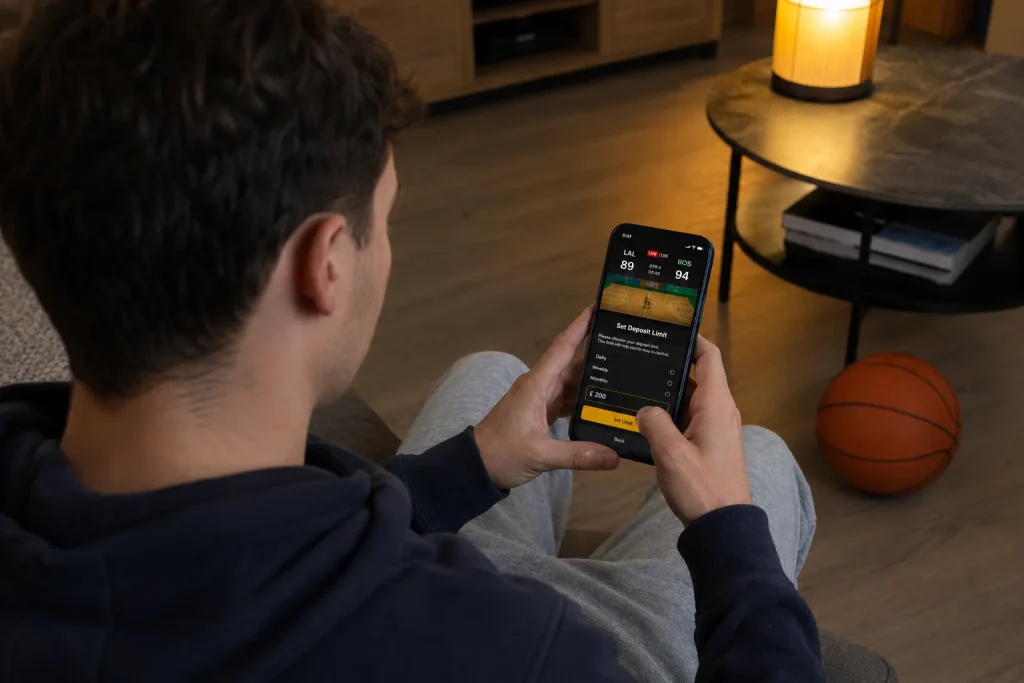
The Bus Ride That Spelled It Out
I was on the 36 bus through south London last winter when I noticed three separate young men around me, all on phones, all on the same UK book’s app, all tracking NBA in-play markets at around 8pm UK time. None of them were watching the game. None of them looked particularly engaged with the underlying basketball. They were tapping through markets, placing bets, watching results, placing more bets. The phones were the entire engagement. The bus ride lasted 22 minutes. Significant money moved across those three accounts in that window.
The UKGC data captures the shape of this. Around 95 percent of UK online bets are placed from home, but mobile-on-the-go usage is the fastest-growing slice within that – 76 percent of 18-24 year-olds bet on mobile, with the bus ride, the lunch break, the walk between meetings increasingly common bet placement contexts. The NBA’s late-night schedule fits the pattern less directly than football does, but the structural setup – mobile-first, app-driven, friction-minimised – applies the same way. The risks that come with this setup deserve direct attention.
The Mobile Share and What Drives It
The 76 percent mobile share among UK 18-24 year-old bettors is part of a broader generational pattern. Mobile-first habits have replaced desktop-based betting for the under-30 audience almost entirely. The smartphone is the primary betting interface. The book’s app is the primary engagement point. The push notification is the primary inbound communication channel. The ecosystem is designed to be frictionless on mobile in ways that no previous generation of UK betting infrastructure was.
For NBA specifically, the mobile share is even higher than the overall sports betting figure. The late-night tip-off times push more betting activity onto phones because the punter is in bed, on the sofa, away from a desk. The schedule structure itself encourages mobile usage in ways that daytime football betting does not. The combination of NBA timing and mobile habits creates an engagement pattern that is distinct from football, racing, or any other UK sports betting category.
Around 86 percent of UK 18-24 year-olds report viewing betting as a form of investment, compared to 79 percent across all UK bettors. The investment framing is part of what shapes the mobile usage pattern – the engagement is treated as productive activity, deserving of regular attention and frequent updates, rather than as occasional entertainment. The framing has consequences for how often the app gets opened, how many bets get placed, and how the deposit and loss patterns develop over time.
The Under-25 Profile in Detail
The 18-24 UK betting demographic differs from older bettors across multiple dimensions. The deposit frequency is higher. The average bet size is smaller but the cumulative volume is comparable. The market preference skews toward in-play, props, and parlays rather than single pre-game spreads. The session length is longer. The proportion of bets placed within minutes of a previous bet is higher.
The NBA fits all of these patterns. Live in-play markets on NBA games are particularly suited to the rapid-bet style. The 99.4 possessions per 48 minutes the league averaged in 2024-25 means roughly two minutes per possession of decision-making time – enough to refresh the app, see the new market, place a quick bet, and watch the next possession unfold. The format is engineered, perhaps unintentionally, for exactly the engagement pattern that young UK mobile bettors are most likely to develop.
The 24 percent of UK adults who bet on sport monthly rises to 52 percent in the 25-34 age bracket. The under-25 numbers are slightly lower than 25-34 but rising. The trajectory is toward higher engagement, deeper integration into daily routines, and more time spent in betting apps overall. The NBA’s growing UK footprint – Prime Video viewership up 444 percent in 2025-26 – feeds the engagement curve directly.
The Investment Narrative Myth
The 86 percent figure for under-25 punters viewing betting as investment is the single most concerning data point in the UK gambling research. The framing is wrong. Betting is not investment by any meaningful definition. Investment generates positive expected returns over long horizons through productive economic activity. Betting on NBA games generates negative expected returns by construction – the book’s vig ensures it.
The investment narrative is partly cultural – the rise of retail trading, cryptocurrency speculation, and online financial discourse has blurred the conceptual line between investing and gambling. UK 18-24 year-olds who came of age during the meme-stock era and crypto cycles often carry that conceptual blur into their approach to sports betting. The book’s app design – portfolios, performance tracking, profit-and-loss visualisation – reinforces the framing.
The practical consequence is that bets sized as if they were investments are sized too aggressively for their actual expected value. A 5 percent bankroll position on a single basketball game prop is not “investing in the position.” It is putting 5 percent of capital on a coin-flip-adjacent outcome with negative expected value. The math is straightforward, but the framing obscures it. The young UK punter who internalises the investment narrative is on a trajectory that the empirical data on long-term betting outcomes does not support.
The App Design Choices That Push Engagement
UK book apps are designed to maximise engagement. The push notification cadence is calibrated to bring users back into the app multiple times per day. The visual design of in-play markets uses motion, colour, and animation to create urgency. The cash-out feature creates emotional checkpoints throughout a bet’s life cycle. The bet builder interfaces are simplified to make multi-leg construction feel intuitive even when the underlying probability math is complex.
None of these design choices are accidental. They are the output of years of A/B testing, user research, and behavioural economics work focused on customer lifetime value. The apps that maximise time-in-app and bets-per-session win the commercial competition. The UK regulatory framework constrains some of the more aggressive engagement patterns – gambling adverts on apps cannot include certain calls to action, time-in-app metrics are not displayed prominently to users, certain promotional patterns are restricted – but the fundamental design optimises for engagement.
For young UK punters, the result is that the app’s interface is more engaging than the underlying betting product warrants. The bet on a Bucks-Heat game is the same betting product whether it is placed through a stripped-down web form or through a high-engagement mobile app. The expected value of the bet does not change with the interface. But the volume of bets placed, the size of positions taken, and the time spent on the activity all rise materially in the high-engagement mobile environment compared to the low-engagement web alternative.
The Friction Tools That Actually Work
The UK regulatory framework has built friction tools into the licensed betting infrastructure specifically to address the mobile-engagement risk. Deposit limits can be set per day, per week, or per month – once set, they are enforced by the operator and cannot be raised without a cooling-off period. Time-out functions allow users to suspend their account for periods ranging from 24 hours to several weeks. Reality checks pop up in-app at user-defined intervals, requiring a pause and a re-engagement decision.
The £150 financial vulnerability check at the 30-day rolling threshold is part of this friction infrastructure. The operator’s compliance team runs the check; the customer receives the notification if the check identifies signals worth flagging. The infrastructure is designed to add friction to the engagement loop at the points where harm is most likely to begin.
The tools are most effective when they are activated proactively, before the engagement pattern has reached problematic levels. Setting a £20 daily deposit limit when opening an account, configuring reality checks at 30-minute intervals during sessions, and using the time-out function to break engagement cycles after losing days are all interventions that work prophylactically. The same tools used reactively, after a problematic pattern has developed, are less effective because the engagement habit is already established.
The Pre-Bet Pause That Costs Nothing
The single most useful discipline I have built across years of UK NBA betting is the 60-second pause between deciding to bet and actually placing the bet. Read the line. Read the bet. Wait 60 seconds. Then place if the bet still makes sense. The pause is short enough to be sustainable as a routine. It is long enough to interrupt the dopamine loop that the app design optimises against.
For young UK punters in particular, the pause is the most cost-free intervention available. It does not require deposit limits, time-outs, or any other formal restriction. It does not reduce betting activity in itself – most bets survive the pause unchanged. What it does is filter out the most impulsive 10 to 20 percent of bets – the ones that feel right in the moment but do not survive even a minute of consideration. Across a season, that filter compounds materially.
The book’s app design works against the pause. The UI nudges toward immediate placement. The animations reinforce urgency. The notifications create artificial scarcity around limited-time markets. The discipline of pausing is genuinely uncomfortable to maintain because the design is optimised in the opposite direction. But it is the cheapest and most effective intervention available to the engaged young UK punter, and it does not require any external infrastructure to implement.
For UK punters who want to understand the regulatory framework that surrounds these mobile engagement patterns – the licensed-operator framework, the consumer protection infrastructure, the dispute resolution mechanisms – the broader picture is covered in the UK regulation and safe play framework, which describes the licensing structure, the harm prevention tools, and the support infrastructure that the mobile-betting environment exists within.
The 76 percent mobile share among 18-24 year-old UK bettors is not going to reverse. The NBA’s growing UK footprint will accelerate engagement among the same demographic. The discipline tools available within the UK regulatory framework are real, useful, and underutilised. The decision about how to engage with the mobile NBA betting environment sits with the individual punter. The infrastructure to engage healthily exists; the practical work is in using it before the engagement pattern requires it.
Frequently Asked Questions
Do UK NBA apps push notifications that nudge under-25 punters into in-play betting?
Yes. UK book apps send in-play notifications during live NBA games, including price-movement alerts, market-opening notifications, and cash-out value updates. The notification cadence is highest during marquee broadcasts and in-play windows. The under-25 demographic receives push notifications at the highest rate among UK age bands because the apps treat younger users as the most responsive to in-app prompts. The user can disable these notifications in the app settings, but the default configuration is for notifications to be enabled across all categories. The most effective single setting change for under-25 punters who want to reduce engagement intensity is to disable in-play push notifications entirely.
What in-app limits can a young UK bettor set in under a minute?
The main UK books all permit deposit limits, loss limits, session time limits, and account time-outs to be set directly within the app, typically with no friction beyond a confirmation step. A daily deposit limit can be set in under a minute. A weekly loss limit takes about the same. A session time limit - usually 30, 60, or 120 minutes - can be configured in seconds. A 24-hour or 7-day time-out is also typically a single-click operation. Once set, these limits are enforced by the operator and cannot be raised without a cooling-off period, typically 24 hours minimum. The infrastructure is designed to make the protective controls as quick to set as the engagement controls are quick to bypass.
