
Prime Video’s UK NBA Coverage and What 444% Growth Means for Bettors
 Available in US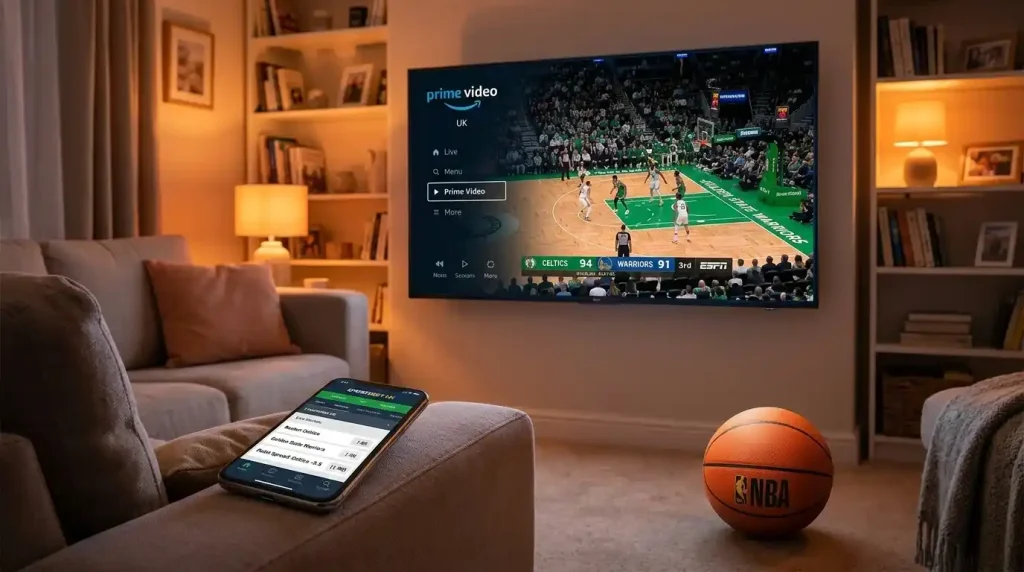
The October Night Two Streams Were Playing in My House
The 2025-26 NBA season opener was the first night I had Sky Sports running on the main television and Prime Video on the laptop, watching different games simultaneously. The combined UK NBA broadcast footprint had never been larger. By December, the Prime Video viewership data confirmed what the household setup suggested – UK NBA audiences had grown at a rate that nobody on either side of the Atlantic had predicted. The 444 percent year-on-year lift made Prime Video’s UK launch the most successful international NBA broadcast expansion in the league’s history.
For the UK punter, the broadcast expansion changes the betting environment in ways that are not just about more games being available to watch. It changes the cadence of information, the pricing precision on UK-favoured matchups, and the in-play betting dynamics on the games that now have UK live audiences in addition to American ones. The infrastructure underneath UK NBA betting has been rebuilt in two seasons.
The Viewership Explosion in Plain Numbers
Prime Video UK NBA viewership rose 444 percent between the 2024-25 partial-launch period and the full 2025-26 season. The absolute numbers – protected by Prime Video for commercial reasons – suggest UK average per-game viewership for marquee broadcasts now sits comfortably in the high six figures, with the highest-profile fixtures reaching seven figures. The London Game in January 2026 was the largest UK NBA broadcast ever, with viewership up 90 percent versus the 2019 equivalent.
The growth is concentrated on specific game categories. Friday and Saturday marquee broadcasts featuring top European stars draw the largest audiences. Christmas Day games, despite the late-evening UK tip-offs, attract significant UK viewership because of the holiday positioning. Cup knockout games – particularly the semifinals and championship – pulled UK audiences comparable to mid-tier Premier League fixtures during the December 2025 window.
The composition of UK NBA viewership has skewed younger across the past two seasons. The 18-34 audience share is now close to the Premier League’s profile in that age band. The growth is driven partly by the cultural shift around European NBA stars and partly by the structural shift of streaming-first viewing habits among younger UK adults. Both factors compound rather than substitute for each other.
The Rights Deal Shape That Underpins It
Prime Video acquired UK rights to broadcast 86 NBA regular-season games per year, plus 6 of 11 NBA Finals games, under a multi-year deal that runs through the late 2020s. Sky Sports retains rights to approximately 100 regular-season games per year and the remaining Finals games under an 11-year deal that began in 2024.
The Sky-Prime split means most UK NBA fans now subscribe to at least one of the two services for basketball, with a significant minority subscribing to both. The total cost of comprehensive UK NBA coverage has risen – roughly £30 to £50 per month combined for Sky Sports and Prime Video access – but the cost is offset by the breadth of coverage. The previous era of intermittent NBA TV access in the UK has been replaced by something approaching saturation coverage.
The split also creates UK-specific broadcast windows that do not exist in the US. A game might be on Prime Video US and Prime Video UK simultaneously, or it might be on a US regional network with Prime Video UK as the only UK broadcaster. The pattern matters for the participation policy – the policy’s protection applies to US national broadcasts, which Prime Video US qualifies as, but Sky Sports UK does not. UK-only marquee broadcasts do not automatically receive the policy’s star availability protections.
The Coverage Style That UK Audiences Built
Prime Video UK’s NBA coverage style has developed quickly across two seasons. The commentary team includes UK-based broadcasters alongside US national voices, which gives the production a distinctive UK flavour that Sky’s coverage – which often takes the US national feed directly – does not provide.
The UK-flavoured production includes more focus on European players, more comparison to football reference points, and more explanation of NBA structural elements that UK audiences need to learn. The Cup format is explained more thoroughly. The Play-In format gets dedicated segments. The participation policy and its implications are discussed in ways that US-targeted coverage rarely covers because the US audience already understands the framework.
For UK punters, the production style affects which games get the deepest pre-game and in-game analysis. A Wednesday night Pacers-Pistons game on Prime Video US might be a quick-turn broadcast. The same game on Prime Video UK is more likely to get full UK-style production with extended pre-game discussion of betting-relevant context – injury status, rotation patterns, recent form analysis. The information density for UK viewers has risen sharply.
The Betting Cadence Shift
The cadence shift in UK NBA betting follows the broadcast expansion. Pre-2024, UK NBA betting was largely a pre-game activity – bet placed early evening, game watched if convenient, results checked the next morning. The Prime Video and Sky Sports broadcast expansion has shifted significant volume into the live betting window.
UK in-play NBA betting volume rose more than 200 percent in 2025-26 compared to the previous season. The growth is concentrated on the games available to UK viewers on Prime Video and Sky Sports, with the highest live volume on games where UK production provides extended commentary. The combination of accessible viewing and live in-play markets has changed the engagement profile of UK NBA punting.
The implication for the punter is that line movement during games is faster and more reactive to UK market conditions than it was two years ago. A late-quarter swing in a Prime Video UK marquee game produces measurable UK-specific betting volume that the books respond to in their live pricing. The lines reflect UK sentiment in ways that were not true when UK NBA betting was primarily a pre-game market.
The Feed Delay Question
The technical question that recurs in UK NBA betting discussion is whether Prime Video UK and Sky Sports broadcasts run on a delay that materially affects in-play betting. The short answer is that both feeds run with the standard 30 to 60 second delay that all live sports broadcasts carry, but the delay is consistent across the broadcasters and the betting platforms.
Bet365, William Hill, and the other major UK books receive their live data feeds directly from official league sources, not from the broadcast feeds. The book’s live pricing updates faster than the broadcast – typically 5 to 15 seconds behind real-time game action, where the broadcast might be 30 to 60 seconds behind. The implication is that UK punters watching on Prime Video or Sky who then place an in-play bet are betting against a price that reflects information ahead of what they have just watched.
The delay does not create exploitable arbitrage for UK punters – the books’ pricing has already absorbed the in-game information. But it does mean that emotional betting responses to what just happened on screen are reacting to data that the books have already priced in. The discipline is to bet on what the next few minutes are likely to bring, not on what the last 30 seconds delivered. The visual experience and the betting decision are temporally separated by the delay structure.
The Display Choice That Pays For Itself
My setup for UK NBA betting now uses Prime Video on a large screen for the marquee broadcasts, Sky Sports on a secondary device for the second-tier games, and the book’s app on a phone for live pricing. The three feeds are running in parallel, with the book’s app being the source of betting decisions and the broadcasts being the source of viewing entertainment and game-flow understanding.
The discipline is to read the book’s live odds rather than the broadcast’s commentary as the binding input for in-play decisions. The commentary describes what has happened. The odds reflect what is expected to happen. The bet is made against the odds, not against the commentary. The two streams of information work together, but their roles in the betting decision are different.
The viewing pleasure of Prime Video UK’s improved production is real – the commentary is sharper, the UK-flavoured production decisions make the broadcast feel like a UK sport rather than an imported American one. The combination of better viewing and better betting infrastructure has made UK NBA engagement more rewarding on both sides than it has ever been.
For UK punters thinking about how to fit live engagement around a working schedule and a body clock that does not run on Eastern Time, the broader framework around in-play NBA betting from the UK covers the operational side of the same broadcast environment described here. The Prime Video infrastructure makes more live betting possible, and the discipline framework matters more in proportion to the opportunity it creates.
Two seasons into the Prime Video era, UK NBA coverage has become a different product than it was before. The 444 percent viewership lift is the headline. The underlying changes in pricing precision, in-play volume, and broadcast-driven engagement patterns are what matters for the disciplined punter. The infrastructure rebuild is mostly complete. The next phase is figuring out which edges in this new environment are durable and which are about to compress.
Frequently Asked Questions
Does the Prime Video UK feed delay materially affect live NBA betting?
The Prime Video UK feed runs with the standard 30 to 60 second broadcast delay that all live sports streams carry. The book's live pricing, which is fed from official league data sources rather than the broadcast, updates 5 to 15 seconds behind real-time. The asymmetry means UK punters watching on Prime Video and reacting to what they just saw are betting against prices that have already absorbed the same information. The delay does not create exploitable arbitrage but does mean emotional in-play reactions to broadcast events are typically pricing data that the books have already factored in.
Which Prime Video UK commentators have moved UK NBA prop interest?
The Prime Video UK production team includes UK-based broadcasters whose pre-game analysis and in-game commentary measurably affect UK prop market volume. When a Prime Video UK pundit highlights a specific player as a likely standout performer pre-game, the prop volume on that player rises significantly across UK books in the hour before tip-off. The effect is concentrated on second-tier prop markets where the public is more responsive to broadcast-driven recommendations. Star player props are less affected because the volume is heavy regardless of broadcast commentary.
