
Decimal vs Fractional Odds for NBA Betting in the UK: The Maths You Should Internalise
 Available in US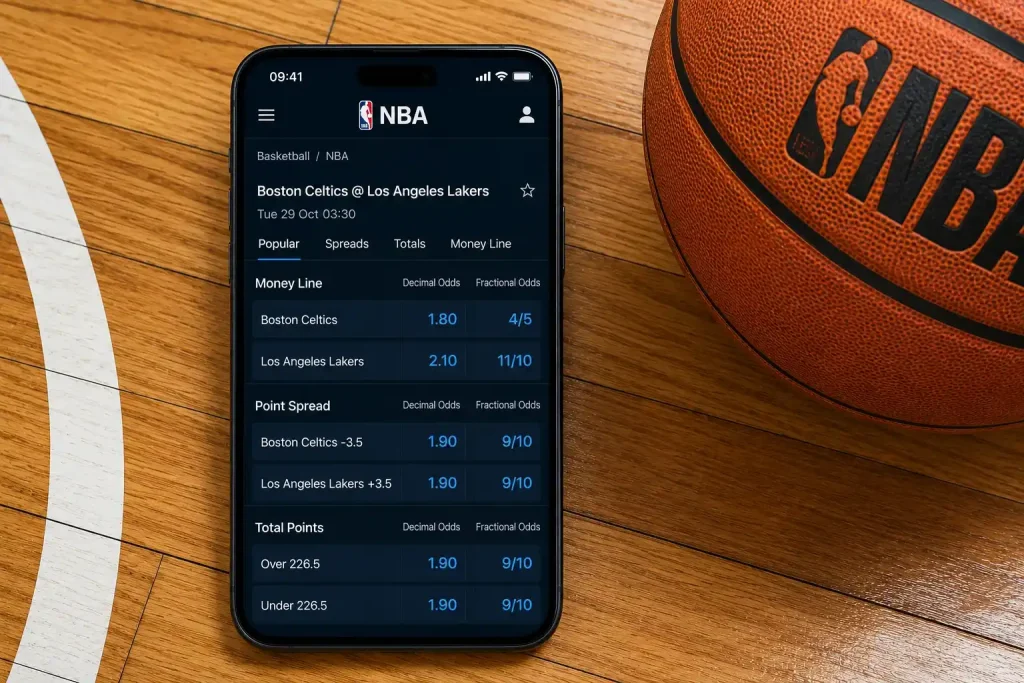
The Format Toggle Most British Punters Get Wrong
I asked a friend last spring whether he wanted 10/11 or 1.91 on a Lakers spread. He chose 10/11 thinking it was the better price. They’re identical. He’d been a UK punter for fifteen years, mostly on horse racing, and he’d never sat down to actually convert between the two formats. He’s not unusual. He’s typical.
UK NBA punters operate in a strange in-between zone. Fractional odds are the legacy format of British betting – every high-street shop quoted them, every grandparent’s first bookies trip used them. Decimal is the format every NBA market in the UK now defaults to on mobile apps, because the maths is faster and the rest of the world (including the leagues themselves) uses it. Censuswide surveyed 2,000 British adults in June 2025 and found 24% make online sports bets at least once a month, climbing to 52% in the 25-to-34 demographic. The growth audience is mobile-first, app-first, and decimal-first.
What I want to walk through is the actual maths – not the marketing maths – that connects fractional, decimal, implied probability, and the American format you’ll occasionally see on Twitter feeds. By the end you should be able to switch formats in your head, recognise which UK book uses which display by default, and convert any NBA price into the only number that actually matters: implied probability.
See also best UK bookmakers for NBA and their odds formats.
How the Formats Sit in UK Betting History
Fractional odds were the dominant format in Great Britain until roughly the late 2000s. The system was built for the bookmaker’s chalkboard – write the price as a ratio (4/1, 7/2, 11/8) and let punters multiply by stake. The system works fine for whole-number ratios and clean horse-race prices. It works poorly for the kind of granular pricing modern NBA markets require.
Decimal odds arrived from continental Europe in the 1990s and slowly took over the UK online market. Bet365 was an early defaulter to decimal display; Bet Victor and Betfair followed. By 2020, the major UK operators were displaying decimal by default on most apps, with a fractional toggle available in settings. The reason is operational: pricing a market at 1.94 versus 1.91 is a meaningful adjustment in decimal but a clunky fraction (94/100 doesn’t reduce cleanly).
UK Gambling Commission CEO Andrew Rhodes has spoken about the importance of the regulator’s transparency role, noting that The Gambling Survey for Great Britain is a key building block of the evidence base which helps government, industry and other partners understand both gambling behaviour and potential consequences from gambling.
Part of that transparency is in the data formats themselves – decimal pricing is more readable, more comparable across operators, and easier to convert into the implied probabilities that actually drive long-run profitability. Fractional pricing obscures small price differences; decimal exposes them.
The practical reality for any UK punter approaching NBA betting: every major UK app now defaults to decimal display, and switching to fractional is a settings choice. If you’ve been betting in fractional for years on football or horses, the transition to decimal is worth making. The arithmetic is genuinely easier once you’ve done it 50 times.
The Conversion Table You Should Know by Feel
The maths is mechanical. Decimal odds equal fractional odds plus 1. A 4/1 fractional bet is 5.00 decimal (4 plus 1). A 11/8 fractional is 2.375 decimal (11/8 = 1.375 plus 1). A 10/11 fractional is 1.909 decimal (10/11 = 0.909 plus 1, which UK books usually round to 1.91).
The reverse conversion: decimal minus 1, then express as a fraction. A 3.50 decimal is 2.50/1, or 5/2 fractional. A 2.10 decimal is 1.10/1, which UK fractional displays as 11/10. A 1.50 decimal is 0.50/1, or 1/2 fractional. The fractional conversion sometimes produces awkward numbers (1.87 decimal is 87/100 fractional, almost never displayed cleanly), which is why decimal is now the working standard.
The conversions I keep in muscle memory for NBA: 1.50 = 1/2, 1.66 = 2/3, 1.75 = 3/4, 1.91 = 10/11, 2.00 = evens, 2.10 = 11/10, 2.50 = 6/4 (also written 3/2), 3.00 = 2/1, 4.00 = 3/1, 5.00 = 4/1, 10.00 = 9/1.
That table covers 95% of the price points you’ll encounter on a typical NBA slate. Spreads cluster around 1.85-1.95. Moneylines on favourites cluster 1.20-1.80. Underdogs cluster 2.00-3.50. The 10.00+ prices live in futures (MVP, championship) and in heavy-leg parlays. Knowing the conversions by feel removes the friction of switching apps mid-shopping.
Implied Probability Is the Only Number That Matters
Decimal odds make implied probability easy. Divide 1 by the decimal odds and you get the implied probability of that outcome winning, as a decimal between 0 and 1. A 1.50 decimal implies 1/1.50 = 0.667, or 66.7%. A 3.00 decimal implies 1/3.00 = 0.333, or 33.3%. The breakeven win rate on any bet is exactly equal to the implied probability.
Fractional odds make implied probability awkward. The formula is denominator divided by (numerator plus denominator). For 4/1, implied probability is 1/(4+1) = 0.20, or 20%. For 10/11, it’s 11/(10+11) = 0.524, or 52.4%. The maths is the same; the keystrokes are uglier.
What you do with implied probability: compare it to your own estimate of the true probability. If you think the Lakers have a 70% chance of beating Memphis and the moneyline is 1.50 (implying 66.7%), the bet has positive expected value – your fair price is 1/0.70 = 1.43, and any decimal above 1.43 is value. If you think the Lakers are actually 60% likely to win, the 1.50 price is overpriced – your fair price is 1/0.60 = 1.67, and the bookmaker’s 1.50 is below fair value.
The hold percentage is implied probability summed across all outcomes minus 100%. On a moneyline market priced at 1.50/2.75, implied probabilities sum to 0.667 + 0.364 = 1.031, or 103.1%. The 3.1% above 100% is the operator’s hold. Across UK NBA moneyline markets, holds typically run 3-6% depending on operator and game. Tighter holds (3-4%) are at Bet365 and the larger operators; wider holds (5-6%) are at smaller UK books with thinner NBA modelling.
The implied-probability check is the single most useful arithmetic habit a UK NBA punter can develop. Every price you click on should go through this check first. Convert decimal to implied probability, compare to your honest estimate of true probability, click only if your estimate is higher. The discipline is brutal but the long-run effect is enormous.
American Odds and Why They Sometimes Show Up
American odds use a different convention. Negative numbers (-110, -250) mean “stake this much to win 100.” Positive numbers (+150, +300) mean “stake 100 to win this much.” The system is mathematically equivalent to decimal and fractional, just presented differently.
Converting American to decimal: for negative odds, decimal = (100 / |American|) + 1. So -150 American = (100/150) + 1 = 1.667 decimal. For positive odds, decimal = (American / 100) + 1. So +150 American = (150/100) + 1 = 2.50 decimal.
You’ll see American odds in three contexts as a UK NBA punter. First, on Twitter and Reddit where American bettors dominate the conversation – every NBA betting discussion online defaults to American format. Second, on some UK-facing US-sourced content (the SportsLine articles, ESPN UK pieces) that hasn’t been fully localised. Third, occasionally on UK exchange apps where international users have set their preference and shared a price screenshot.
The cleanest mental shortcut: -110 American is exactly 1.91 decimal, which is the standard NBA spread price. -150 is 1.67 decimal. -200 is 1.50 decimal. +150 is 2.50 decimal. +200 is 3.00 decimal. The conversion takes 30 seconds with a calculator and ten readings of an NBA spread market to commit to memory.
Choosing Your Display: Decimal Wins on the NBA
Bet365 carries 140+ NBA markets per game and displays all of them in decimal by default. Unibet carries 50+ markets per game, also defaulting to decimal. Most major UK operators follow the same pattern. The fractional toggle exists in app settings but is increasingly buried behind one or two menu screens.
Why decimal wins for NBA specifically: the spread market clusters tightly around 1.90-1.92 prices, where fractional display (10/11, 9/10, 21/20) becomes unwieldy and small price differences are hard to compare across operators. Decimal exposes the price difference cleanly – 1.91 versus 1.94 is visibly different in a way that 10/11 versus 47/50 isn’t. Line shopping across UK operators is materially easier in decimal.
For UK punters new to NBA betting and considering whether to switch display: do it. The transition takes a fortnight to feel natural and pays dividends every time you price a bet thereafter. Fractional is the legacy format with sentimental appeal; decimal is the working format that connects to implied probability with one division. If you want to extend the format thinking into the actual moneyline market and how favourite-versus-underdog pricing plays out in decimal, my breakdown of NBA moneyline betting in the UK walks through the decimal-implied-probability conversions in more detail.
The Display Choice That Pays For Itself
The format you use doesn’t change the price. Decimal, fractional, American – the same bet pays the same return regardless of how it’s displayed. What the format changes is how easily you can convert to implied probability, how readable price variation is across UK operators, and how quickly you can spot value on a slate of 12 NBA games. Decimal wins on all three dimensions for basketball. The investment is settling on one format and learning to feel the implied-probability conversions in real time. The payoff is every line shop, every value check, and every clean read of a market that suddenly feels less like a foreign language and more like the obvious arithmetic problem it always was.
See also nba betting help for the complete NBA betting guide.
Yes - every major UK operator (Bet365, William Hill, Sky Bet, Paddy Power, Ladbrokes, Coral, Unibet, Bet Victor, Betfair) defaults to decimal display on NBA markets via mobile app. The fractional toggle exists in account settings, typically two or three menu taps deep. Some operators retain fractional as the default for horse racing while using decimal for football, basketball, and US sports. If you switched on a horse racing app to fractional, your NBA display may have switched too - the toggle is usually account-wide, not market-specific. +145 American converts to 2.45 decimal (145/100 + 1 = 2.45). In fractional, +145 reduces to 145/100, which UK books would display as 29/20 (dividing both numbers by five). On the mobile app of any major UK operator, you'd see the price as 2.45 or 29/20 depending on your display setting. The implied probability is 1/2.45 = 40.8% - the bookmaker thinks this outcome wins about 41% of the time. Any honest estimate above 41% makes the bet a value play.Frequently Asked Questions
Do UK bookmakers default to decimal odds on NBA mobile apps?
How is a +145 American line shown in fractional and decimal at a UK book?
