
NBA Point Spreads and Handicaps for UK Bettors: From -5.5 to Decimal Reality
 Available in US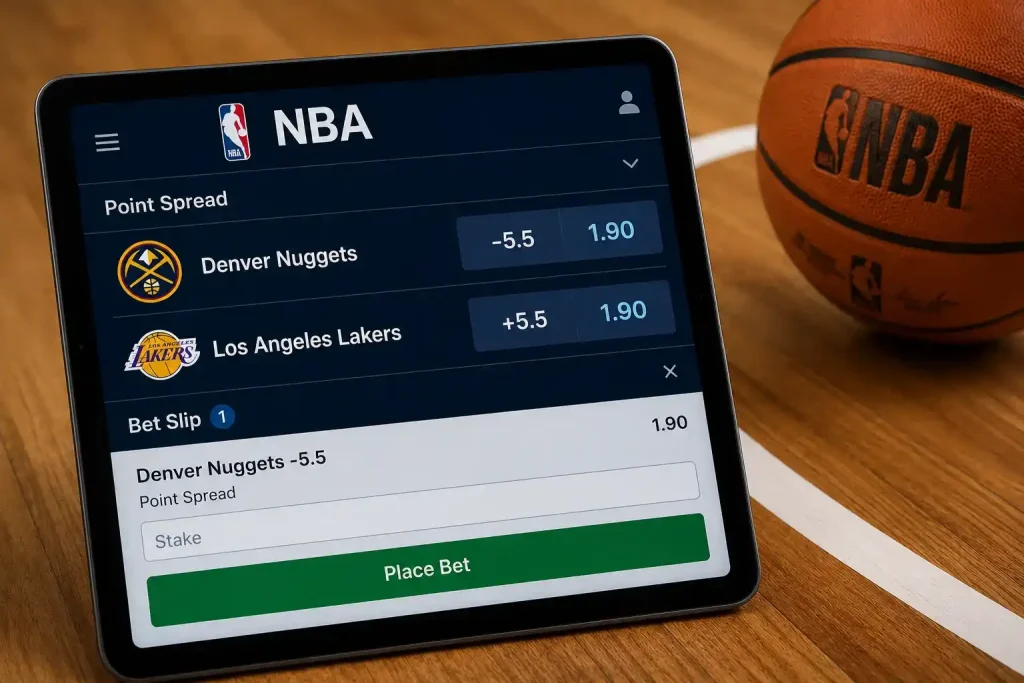
The Spread Number That Most British Punters Misread
A reader emailed me in November asking why his -7.5 Warriors bet lost when Golden State won by seven. He’d held the ticket convinced he was right. He wasn’t. That single misunderstanding – that -7.5 means winning by at least eight, not at least seven – has cost UK punters more money in this market than every back-to-back fade combined.
The NBA spread market is the most important price on the slate. It’s where sharp money lives, where Vegas does most of its work, and where the strongest correlation in basketball – three-point volume against home court advantage running at r = -0.88 from 1983 to 2025 – quietly reshapes every line you see. Yet UK books still display it in a format that doesn’t quite map onto what British punters grew up with.
I want to walk through the spread the way I learned it: mechanics first, decimal pricing second, the specific numbers that matter in basketball third, and then the home-versus-road dynamics that decide whether a -5.5 line is fair or fishing for your money. By the end, the next reader who emails me about a covered-by-half-a-point loss will at least know exactly why his stake’s gone.
See also NBA totals and over/under betting as a complementary market.
How a Point Spread Actually Settles
A spread is a points-handicap applied to the final score. If the Lakers are -5.5 against Memphis, the Lakers need to win by six or more for the bet to cash. Memphis at +5.5 covers if they win outright or lose by five or fewer. The half-point – “the hook” – exists to remove pushes. You either win or lose; no money back.
UK books quote spreads with decimal odds beside them, almost always around 1.90 to 1.92 on each side. The price reflects the book’s hold rather than the team’s actual strength – the spread itself is the work, and the decimal is the cost of admission. A spread quoted as -5.5 at 1.91 on each side runs a hold of about 4.7%, which is competitive across UK NBA markets.
When you see a spread move from -5.5 to -6, that’s the line, not the price, doing the work. The book has decided the favourite is actually six points better than the underdog, not 5.5. That half-point movement matters. If you’d bet at -5.5 and the line moves to -6.5, you’ve “won the close” – your number is still the original.
Spreads include overtime exactly the way moneylines do. A team trailing by ten with two minutes to play that hits a buzzer-beater three to send it to overtime, then loses by four, has cost the punter who took them at +9.5 the entire stake. That kind of swing is part of the market. The three-point variance the modern NBA produces is a huge part of why spread lines move so much in the final five minutes of any close game.
Decimal Pricing on the Handicap
Most British punters arrived at NBA spreads after learning fractional handicaps on football. The format is different. NBA decimal handicap pricing sits at 1.91 on each side as a working baseline, which translates roughly to 10/11 fractional or -110 in American odds. The structure tells you something useful: the book is offering near-50/50 propositions and taking a small slice from each side regardless of who wins.
Implied probability on a 1.91 spread is 1 ÷ 1.91 = 52.36%. With both sides at 1.91, the combined implied probability is 104.7%, which is the 4.7% hold. To beat the spread market long-term you need to hit roughly 52.4% of your bets just to break even, before accounting for variance or sample size.
I see UK punters confuse themselves with the “implied probability” idea because the spread isn’t pricing who wins – it’s pricing whether the favourite covers the handicap. The bet at -5.5, 1.91 isn’t asking “will the Lakers win?” It’s asking “will they win by six or more?” That distinction is everything. A favourite can win the game and lose the bet.
One trick I drill in early: convert decimal handicap prices into the breakeven win rate. 1.91 = 52.4% breakeven. 1.85 = 54.1% breakeven. 1.95 = 51.3% breakeven. The price movement tells you how much edge a sharp model would need to make the bet profitable. A 1.85 spread requires almost two percentage points more accuracy than 1.95 – and over a 200-bet season that gap is worth real money. Line shopping across UK books to grab the better decimal on a spread you’d take anyway is one of the lowest-effort ways to add basis points to your bottom line.
The Key Numbers in NBA Spreads
An NFL spread punter will tell you about 3 and 7 as key numbers. The NBA has its own set, but the rhythm is looser. The most common margin in close NBA games is two points, courtesy of a missed three followed by an and-one or a turnover. Three is also common, since trailing teams hunt threes in the final minute. The clusters – 1, 2, 3, 5, 7, 10 – appear more often than other margins.
Why does this matter? Because half-point movement around those clusters is the most expensive insurance you can buy. Moving from -2.5 to -3 costs you almost nothing because three-point margins are common – the half-point gives you push protection against an exact-three loss. Moving from -3 to -3.5 is the same idea, just on the other side. Books charge differently for those half-points; on quieter UK markets you can sometimes shop a -2.5 at one operator while another offers -3 at the same price.
I’ve watched UK punters take -5.5 over -5 thinking the half-point is “free protection” against a five-point loss. Five-point margins do happen, but not at the rate three-point margins do. The extra-half-point premium isn’t always worth paying. The principle: pay for the half-point only when you’re crossing a true cluster number. If the line is at -5.5 and you can lay -6 for the same decimal at another UK book, take -5.5 every time. The half-point in either direction at non-cluster numbers is rarely the difference.
Variance has pushed those clusters wider in the modern NBA. Across the 2024-25 season three-point attempts averaged 37.6 per game versus 2.4 in 1983, and the result is that more games now finish on a heave or a free-throw sequence that creates non-standard margins. You’ll see more 4-point and 6-point finals than a decade ago. The cluster numbers still matter, but the curve has flattened.
Home Spreads, Road Spreads and a Quiet Asymmetry
The NBA’s average home win percentage in 2024-25 sat at 54.4%, with the range running from 85.4% at Oklahoma City to a brutal 20.0% at Washington. That isn’t a number to memorise – it’s a sanity check. Any UK book offering a Thunder home spread at -3 against an average opponent is asking you to lay a number that’s smaller than the team’s home edge alone would justify. The line baked in the away team’s strength, the rest situation, the pace mismatch and everything else. But the home court premium starts as a real number.
Road spreads are where I find more of my plays. UK markets inherit a lot of opening lines from US books, where home court advantage has been gradually drifting downward for decades. The correlation between rising three-point attempts and falling home court win rates is one of the strongest signals in modern basketball – r = -0.88 across the 1983-to-2025 window – and the books have been slow to fully price it. Road dogs of three to seven points against home teams that aren’t elite often offer better-than-priced value.
The trap on the home side is sitting on a -7.5 favourite at home against a sub-.500 opponent and assuming the bigger team simply rolls. The home-team cover rate league-wide is closer to 50% on adjusted lines, not 54%. That’s because the books have already moved the line to account for home court. The 54.4% straight-up home win rate isn’t the same as the home-cover rate; the spread does the heavy lifting and forces the market back to roughly even money.
Where I’ll lay a home favourite without flinching: rested versus tired, especially on a Saturday night home game against a road team that lost in OT on Friday and travelled. Where I won’t: a national TV game where the public is already hammering the home side, pushing the spread half a point past where the model says it should sit. If you want the deeper rationale for those spot plays, my NBA betting strategy guide for UK punters walks through the schedule, pace and back-to-back edges in more detail.
Asian Handicaps on the NBA at UK Books
Asian handicap markets have crept into UK NBA offerings over the last five years, mostly through the bigger continental-facing operators. The product is borrowed from Asian football betting and offers quarter-point handicaps – -5.25, -5.75 – that split your stake across two adjacent whole or half lines. A -5.25 bet is half on -5 and half on -5.5; a -5.75 is half on -5.5 and half on -6.
The mechanics: if your team wins by exactly five with a -5.25 spread, half the stake refunds (the -5 leg) and half loses (the -5.5 leg). It’s neither a full win nor a full loss. The product is built to reduce variance and give bettors more granular ways to price exact-margin games. In the NBA, where margins cluster at certain numbers, the quarter-point handicaps offer a way to express conviction without paying full juice for half-point protection.
Not every UK book offers Asian handicaps on the NBA, and depth varies wildly. The exchange-based operators tend to carry deeper Asian markets; the high-street brands usually stick with the standard half-point spread. If you’re tempted by the format, start small. The maths is identical to standard spread maths once you get used to splitting the stake, but the psychology of seeing half a refund and half a loss takes a slate or two to adjust to.
Pulling It Together for the Next Slate
The spread is the most efficient market on the NBA board, which is a different statement from saying it’s beatable. It is – narrowly, by people who think in implied probability rather than gut feel, and who recognise that home court advantage is no longer the league-defining edge it was when the modern spread market was invented. Internalise the cluster numbers, treat the half-point as a paid insurance product rather than a free safety net, and shop the decimal price across multiple UK books on every bet you’d otherwise take blind. The arithmetic does the rest.
See also nba betting help for the complete NBA betting guide.
The half-point matters most when it crosses a cluster margin. Five-point NBA margins happen often enough that -5.5 forces the favourite to win by six, which clears a tougher hurdle than -4.5 which only needs a five-point win. The cluster numbers in NBA basketball - 1, 2, 3, 5, 7, 10 - are crossing points where each half-point can change cover rates by 3-5 percentage points. -4.5 sits below the five-point cluster; -5.5 sits above it. That structural difference is why one number consistently covers more often than the other across long samples. A handful of UK-facing operators carry Asian handicap markets on the NBA, mostly the larger continental-style books and exchange platforms. Depth varies - you'll typically find the standard quarter-step lines (-5.25, -5.75) on marquee games but only the main half-point spreads on Tuesday-night slates. High-street UK brands usually stick with the standard half-point spread. If you want full Asian handicap coverage on every NBA game, an exchange usually offers the deepest book.Frequently Asked Questions
Why does -5.5 cover less often than -4.5 in the NBA?
Do UK bookmakers offer Asian-style 0.25-step handicaps on NBA?
