
NBA Player Props for UK Bettors: Points, Rebounds, Assists and the PRA Market
 Available in US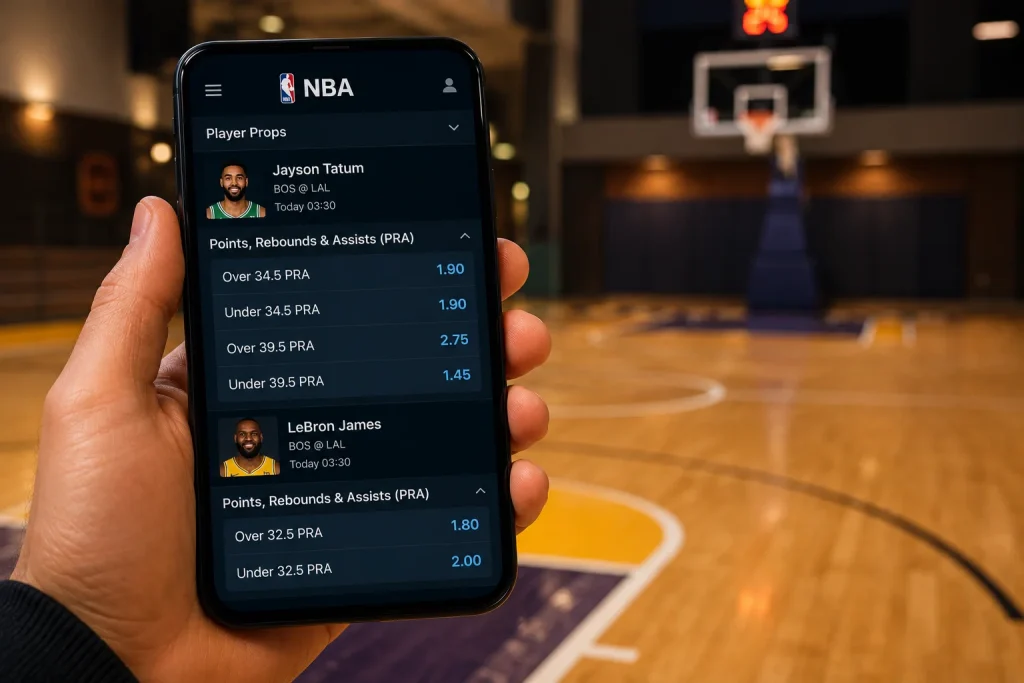
The Quietest Edge on the UK Slate
The first NBA prop I ever cashed was Russell Westbrook Over 9.5 assists against Sacramento. The line was a gift – he averaged 11 that season – and I felt like a genius for sixty seconds. Then I watched bet365 take exactly the same prop down forty seconds later when sharps hammered it. That’s the whole player prop market in one ticket: the soft lines exist, they don’t stay up long, and the operators with the deepest NBA market also adjust the fastest.
UK player prop coverage has exploded since Prime Video took on NBA rights. Bet365 now carries more than 140 markets per NBA game, with player props making up the majority of that depth. Unibet sits around 50-plus markets, with most of the inflation coming from props rather than spreads or totals. The British punter who treats props as a side-curiosity is leaving the most beatable market on the slate untouched.
The trick to props is that you’re not betting on a team outcome – you’re betting on a single human’s production, which depends on minutes, role, matchup, foul trouble, and a hundred small things that flow downhill from the team’s game plan. Modelling props is more granular work than modelling spreads, but the lines are softer because the books model props with less invested data than they put behind the main markets. That gap is the opportunity.
See also the Porter prop bet case for integrity context.
The PRA Market and What It Actually Counts
PRA stands for points, rebounds, and assists combined. The market sums those three counting stats for a named player and prices an Over/Under line – for example, Anthony Davis PRA Over 38.5 at 1.91. If Davis finishes the game with 27 points, 9 rebounds, and 4 assists, his PRA is 40 and the Over cashes. Simple to read, but the underlying maths is more layered than it looks.
The PRA market exists because variance on any single stat is high, but the sum of three correlated stats is much more stable. A player who has an off night scoring usually compensates with more rebounds or playmaking touches; a player who can’t get rebounds because he’s playing against a tall opponent usually still scores. The combined number smooths the variance and gives books a line they can price with reasonable confidence.
UK books treat PRA settlement the same way they treat the underlying stats – overtime is included, technical free throws count, and bench minutes count. If a player tweaks his hamstring in the second quarter and is ruled OUT for the rest of the game with 16 PRA, the bet usually still settles (read your operator’s specific rules; some void if the player plays fewer than a stipulated number of minutes, often 15 or 20). The void rule is one of the most important things to check before clicking.
What surprises UK punters new to the market: PRA lines for stars sit between 35 and 55 depending on usage rate and pace. A high-usage primary scorer on a fast-paced team might have a 52.5 PRA line; a low-usage role player on a slow team might be at 18.5. The variation tracks the player’s expected production almost linearly, with small adjustments for matchup. Memorising rough PRA bands for the league’s top 30 players is one of the highest-value prep tasks I do each season.
Usage Rate as the Single Best Predictor
Usage rate is the percentage of team possessions a player ends with a shot, free throws, or a turnover while he’s on the floor. It’s the single best predictor of PRA volatility. A player with 32% usage on his team – Joel Embiid, Luka Doncic, Shai Gilgeous-Alexander – has roughly twice the offensive volume of a player with 18% usage. That doubles the variance on points props and significantly amplifies PRA swings.
The edge lives in usage-rate shifts. When a primary scorer is ruled OUT, his team’s possessions don’t vanish – they redistribute. The second-option scorer’s usage jumps from 22% to 28-30% for that game. Books move his points line up by 2-3 points, but they often under-move because they’re modelling expected production rather than backed-out usage redistribution. The result: the absent-star secondary scorer’s points line is frequently a value Over when the news drops 90 minutes before tip-off.
I worked through this with a punter who’d been playing props for two seasons without tracking usage. He was guessing on lines. We pulled up team-level usage tables for the 2024-25 season, ranked every player by usage rate, and built a simple model: when a 30%-usage star sits, his team’s bottom-three usage players gain 2-3 percentage points each. That single insight changed his prop hit rate from 47% to 54% over the next 80 bets. The market wasn’t pricing the secondary-effects properly, and the work to identify them took two hours of spreadsheet time per slate.
One usage-related warning: minutes restrictions. A player returning from a four-game absence will often be on a “minutes restriction” of 25-28 instead of his usual 33-36. Books adjust the line down for the projected minutes, but they sometimes don’t apply the restriction tightly enough. If a 36-minute regular is restricted to 26 minutes, his PRA line should drop roughly 25-28% – anywhere short of that is a soft Under.
Pace, Props and the Possessions Multiplier
I built a habit early of always checking the matchup pace before clicking any prop. The reason is simple: more possessions means more shots, more rebounds, more assists, and more total PRA available for any player on the floor. The 99.4 league-average pace for 2024-25 produced certain PRA expectations. Matchups well above or below that anchor materially shift those expectations.
Take a player averaging 38 PRA on a team that plays 99 possessions per game. Drop him into a road game against a team playing 104 possessions. His expected PRA, all else equal, rises by 4-5%, since he’s getting more touches per minute and shooting more. That’s 1.5-2 PRA, which is the difference between Over and Under on many prop lines.
The reverse trap: a fast-pace player going on the road against a slow defensive team. Pace compresses to the average of the two teams (closer to the slow side), and the player’s expected PRA drops 3-4%. Books model this, but they often soften the move because the player’s identity (a high-volume scorer) overpowers the matchup adjustment in the line-setter’s head. Persistent Under value exists on those exact spots – high-usage stars going against teams that limit possessions.
One more pace nuance: late-game garbage time. A 25-point blowout in the second quarter means the starters likely play 28 minutes instead of 35. That cuts PRA by 15-20% from the prop expectation. If you took an Over and the game blows out by halftime, the prop is in serious trouble regardless of whether the player has 12 PRA at the break. Watching the live game state matters; the pre-tip line doesn’t know what the game flow will look like.
Shopping Prop Markets Across UK Books
Every UK book sets PRA lines independently, sourcing from different data providers and different in-house modellers. The result is line variation. The same player on the same night can have a PRA line of 35.5 at one operator and 37 at another – and the implied probabilities sit in completely different places. Shopping the line is the cheapest edge available in this market.
The Bet365 NBA market depth of 140+ per game means they’re often the line-setter – they post first, the market reacts. Unibet at 50-plus markets often runs slightly behind on adjustment, which means stale lines linger for 15-30 minutes after a Bet365 move. That gap is harvestable if you can monitor two screens.
The smaller UK operators – the ones with thinner NBA market coverage – often have the softest lines because they’re not putting modelling resources into the product. They’re inheriting numbers from data feeds and adjusting only on the biggest moves. If you’ve got accounts at three or four UK books and you’ve identified a player you want to back, run the line across all four and take the best number. Two percentage points of implied probability difference is real money over a season.
One thing I want to flag: the bet limits on player props at UK books are materially lower than spread and total limits. A book that will accept £500 on a spread might cap a player-points prop at £50 or £100. That’s a deliberate choice on the operator’s side – props are softer markets and the book is hedging against being wrong. For a UK recreational punter that limit is rarely binding; for someone building a serious prop volume it’s a constraint that shapes which markets are worth chasing.
The Integrity Layer Behind Every Prop
Anyone betting NBA props from the UK in 2025 or 2026 needs to know the Jontay Porter case. Porter was a Toronto Raptors bench player who in 2024 was permanently banned by the NBA for tipping off bettors that he would deliberately underperform on prop bets, then leaving games early to ensure the Under hit. Sportradar’s integrity monitoring flagged unusual betting patterns, the FBI got involved, and the case became the template for how prop bet integrity is now policed.
Sportradar’s 2025 integrity report flagged 233 suspicious basketball matches globally, including NBA contests where prop patterns didn’t match performance trajectories. That’s the second-highest sport behind football, which clocked 618 flagged matches. The data suggests prop manipulation at the player level is a real and recurring risk, and the leagues have responded by increasing scrutiny on bench rotation players whose underperformance can be engineered without affecting team outcomes.
What this means for a UK punter: stick to props on starters and rotation regulars. The deep-bench guys who get 12 minutes and have a 6.5 points prop line are statistically the most likely to appear in integrity flags. Some UK books have quietly removed the smallest-volume players from prop offerings entirely. For UK punters wanting the deeper story on how the Porter case unfolded and what it means for the wider prop market, my breakdown of Sportradar’s 233 flags and the Jontay Porter case walks through it.
The clean version of the advice: prop bet the names you know are playing 30 minutes, on lines that move with the data, at operators with deep markets and fast adjustment. Skip the 8-minute bench gambler’s-prop. The expected value isn’t there, the integrity risk is real, and a clean ticket on a healthy star at fair value is the entire reason this market exists.
Building a Repeatable Prop Routine
The punters who make money on NBA props all share the same workflow: usage check, pace check, minutes-restriction check, line shop across two or three UK books, click only if the implied probability gap is at least 3%. That’s it. The market rewards patience and granular pre-game work more than any other NBA market. Pick the players you understand, build a small watchlist for each night, and let the soft lines come to you. The slate is too big to chase every game, and the books are too sharp to forgive lazy clicks. Treat props like a craft and the numbers eventually fall your way.
See also nba betting help for the complete NBA betting guide.
Most major UK operators carry rebound props for the starters and the top two bench players on every game - that's typically 12-15 players per matchup. For the deepest rebound-prop coverage, Bet365 leads on volume at 140+ NBA markets per game. Smaller operators stick to the names with double-digit rebound averages. If you want a specific bench rebounder's line, you may have to use Bet Builder or build a custom selection rather than expecting it on the standard prop board. Props are softer markets and the book is hedging against being wrong. Spreads carry billions in betting volume globally and the lines are aggressively shaped; player props carry far less volume per market, so any single sharp player who finds a soft prop line can move it significantly. Limiting maximum stake to £50-£200 on a prop versus £500-£2,000 on a spread keeps the operator's exposure within the model's confidence interval. For most UK recreational punters those limits never bite.Frequently Asked Questions
Do UK books offer rebound-only props for every NBA game?
Why are NBA prop limits lower than spread limits at UK bookmakers?
