
Same-Game Parlay on the NBA in the UK: Correlation, Hold and Realistic ROI
 Available in US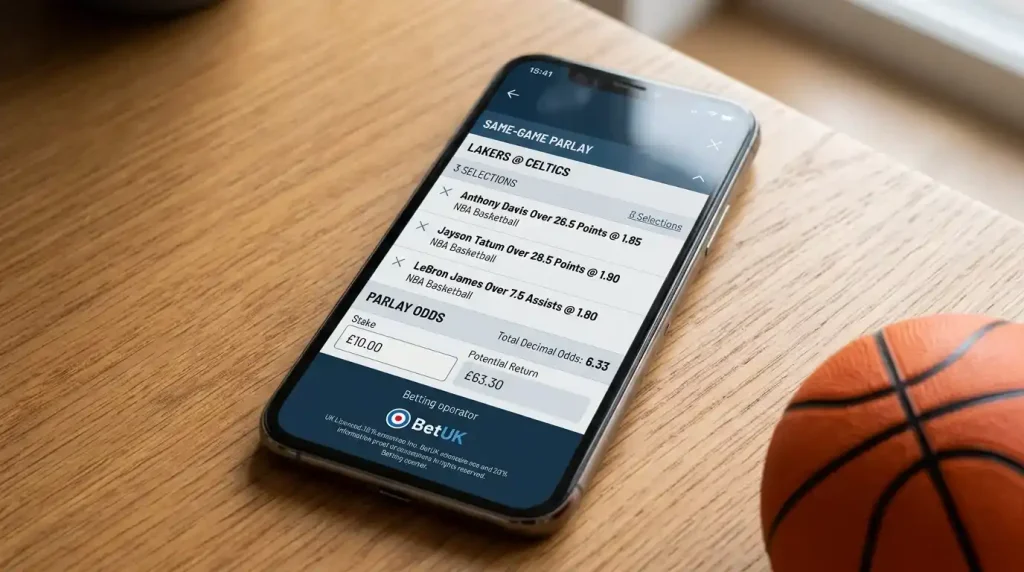
The Market That Pays for Holiday Homes
The regulated US sports-betting market produced $166.94 billion in handle in 2025 with revenue of $16.96 billion – a 22.8% jump in operator income year-on-year. A meaningful chunk of that revenue uplift wasn’t from spreads or moneylines. It was from same-game parlays. The product converts low-margin spread bets into high-margin combination tickets, and basketball is the perfect sport for it because correlated outcomes are everywhere.
British punters get the same product under different names – Bet Builder, Same Game Multi, Same Game Acca – and the mechanic is identical. You pick multiple outcomes within a single NBA game, the book bundles them at a price that accounts for correlation, and you click. The hold on these tickets is often two to three times the hold on the underlying single bets. That’s a huge gap, and it’s why SGPs are the most profitable product on the operator’s side.
What I want to do here is unwind the maths. We’ll look at what correlation actually means in the prop context, how to find legs that work together without forfeiting all your EV to the operator’s correlation premium, and what realistic ROI looks like on these tickets after a 200-bet sample. The product isn’t a no-go zone for British punters. It just rewards a sharper read than most casual SGP players bring to it.
See also NBA player props PRA for building parlays.
Bet Builder, SGP, Same Game Multi: All the Same Game
UK terminology around this market is messier than it should be. Bet Builder is the most common brand name at British operators – Sky Bet, William Hill, Paddy Power all use it. Same Game Parlay is the imported American term that DraftKings and FanDuel use, and it’s filtering into UK marketing. Some smaller operators call it Same Game Multi. The product is the same: multiple selections from a single NBA game, priced as a combined parlay.
What’s actually happening behind the screen: the book runs a model that estimates the joint probability of all your selected outcomes occurring together. If you’ve picked Lakers -5.5 and Anthony Davis Over 28.5 points, those events are positively correlated – Lakers winning by six or more usually means Davis scored well. The model adjusts the combined price downward versus a naive multiplication, because pure-multiplication would let bettors exploit the correlation.
The book’s correlation adjustment is what creates the hidden hold. A naive parlay of 1.91 × 1.91 would offer 3.65 in combined decimal odds. The same SGP, with correlation adjustment, often comes in at 2.80-3.10 – a 15-25% reduction in payout for the same selections. That reduction is the operator’s correlation premium, and it’s where the SGP product makes its money.
What distinguishes Bet Builder from a “true” SGP in the UK: some Bet Builder products at UK books are more restrictive about which selections can be combined (cash-out rules, prop limits, cap on number of legs), while pure SGP products at exchange-style operators are more flexible but priced more aggressively. Read the small print before you build your ticket.
Correlation Maths Without the Headache
Correlation between two outcomes describes how often they occur together versus how often you’d expect them to occur together if they were independent. A simple way to think about it: if Anthony Davis scoring 28+ happens 50% of the time, and the Lakers winning by 6+ happens 50% of the time, you’d expect both to happen 25% of the time if they were independent. If they actually happen together 35% of the time, the events are positively correlated.
NBA games have strong correlations everywhere. Examples I see all the time: high-scoring games correlate with both teams covering the Over and individual player Over props hitting. Low-scoring games correlate with Unders across the board. A winning team’s primary scorer almost always has a strong night. A losing team’s primary scorer is usually shooting more (failed comeback attempts) and his shot-attempt prop often hits.
The trap UK punters fall into: assuming negative correlation is a way to “diversify” an SGP. Picking the Over on a team’s points AND the Under on the game total is mathematically incoherent – if the team scores well, the total tends to be high, not low. The book prices that mismatch by giving you slightly better odds than naive multiplication, but the joint probability is so low that the expected value is terrible.
The maths I use: positive correlation means the book’s price is too short relative to naive multiplication, but the joint probability is higher than naive estimation, so the expected value can still be positive if I’ve picked the right correlated legs. Negative correlation means the book’s price is closer to naive but the joint probability is lower than naive – net result is usually negative EV. Stick to positively correlated legs that you can mechanically explain why they go together.
The cleanest correlation play in NBA: combine the favourite to win moneyline with the favourite’s primary scorer to clear his points prop. If Lakers are 1.50 moneyline and Davis is at 1.91 to score Over 28.5, the naive parlay is 2.87. The book will likely offer 2.50-2.65 (correlation adjustment). If you think the favourite wins 70% and Davis scores 28+ 55%, joint probability with reasonable correlation is around 42%. Fair price is 2.38. The book’s 2.50-2.65 is above your fair price – small but real positive EV.
Where the Hold Hides on UK SGP Pricing
Bet365 carries 140+ NBA markets per game and supports Bet Builders with up to 12 selections. Unibet offers around 50+ markets and similar Builder depth. Smaller UK operators cap the Bet Builder at 6 or 8 selections, partly because their modelling capacity for correlation can’t handle the combinatorics of 12-leg builders.
The hold on these products varies by operator and by selection mix. On a clean two-leg correlated SGP (moneyline + primary scorer prop), the hold runs 8-12% – twice the standard single-bet hold of 4-6%. On a five-leg SGP combining team total, player points, player rebounds, player assists, and game total, the hold can run 18-25%. On twelve-leg SGPs, the hold often exceeds 30%. Every additional leg compounds the correlation premium.
What this means in plain terms: a 12-leg SGP at 25.0 decimal needs to win one in 25 attempts to break even on stake. But the implied fair price might be closer to 18.0 or 20.0, which means you need to win one in 18-20 to actually break even on EV. Most casual UK punters playing 12-leg SGPs are running at 50-60% of fair value, which is a guaranteed long-run loss even on tickets that occasionally cash.
The line I draw for myself: never build an SGP beyond four legs. The correlation premium compounds too aggressively beyond that point. Two-leg or three-leg correlated builders, priced sharply, on legs I’d back individually, are where the SGP product actually generates positive EV. Everything beyond four legs is a lottery ticket with bad odds – fine to play occasionally for fun, but not a strategy.
Legs, Variance and the Hit-Rate Reality
I tracked a UK punter’s SGP history for six months in 2024. He played 187 SGPs averaging 4.8 legs each at average decimal odds of 8.4. He cashed 16 of them – an 8.6% hit rate against an implied breakeven hit rate of 11.9% (1 ÷ 8.4 = 11.9%). His ROI was -28% on £4,200 of stake. The cashed tickets felt amazing; the math told the truth.
The variance on a five-leg SGP is enormous. Even with positive correlation and sharp leg selection, you’re asking five different things to go right within a single game. NBA games have heavy second-half variance from three-point shooting, foul trouble, and rotation changes. One leg goes wrong and the entire ticket dies. The emotional pull of “if only one had hit” is the operator’s best ally.
What works: smaller-leg builders with correlated outcomes you’d back at single value. What doesn’t: bigger-leg builders relying on a low-probability home run. The shape of expected value in SGP is shockingly steep – the difference between a two-leg sharp SGP and a five-leg lottery SGP is the difference between a +2% EV ticket and a -25% EV ticket, on the same underlying game.
One more thing about variance: a streak of five lost SGPs in a row feels devastating, and the temptation is to chase. Don’t. SGPs are high-variance by construction. A 12% true hit rate means you’ll lose 8 in a row roughly 8% of the time. That’s a normal session, not a sign you’ve lost your edge. Stake sizing on these tickets matters – keep them at 0.5-1% of bankroll per attempt, not the 2-3% you might use for spreads.
Two SGP Templates That Actually Work
Template one: the favourite-and-scorer two-leg. Take the home favourite’s moneyline at 1.45-1.70 and combine with the favourite’s primary scorer to clear his points line. Positive correlation, two legs, modest premium, clean read. Decimal price comes in around 2.30-2.80 depending on operator. I take this ticket 8-12 times per month during NBA season; my long-run hit rate is roughly 41-44% against an implied 36-43% breakeven depending on the price.
Template two: the road dog and Under total. When a road dog is priced 2.20-2.80 and you’ve identified a slow-pace matchup with a low total, combining the road dog moneyline with the game Under is mechanically coherent. The dog needs the game to stay close (low scoring helps the worse team), and the Under needs both teams to underperform offensively. Positive correlation, two legs, decimal often around 4.50-5.50. Lower hit rate (15-22%), but the price is high enough to offset.
Templates I avoid: anything involving more than one player prop in the same builder. Player-prop correlation is harder to model and the book’s correlation premium is higher because individual stats are more independent than people think. Two starters from the same team scoring well sounds correlated, but in practice the usage they take from each other often cancels out the joint upside.
I want to be clear about something: SGP isn’t a market I’d build a portfolio around. It’s a side play, with strict templates, strict leg caps, and strict stake sizes. The product exists because it’s profitable for the operator, and the only way to push back against that is to play it less often than the marketing nudges you to. For a fuller breakdown of how Bet Builder products specifically differ across UK books – selection caps, cash-out treatment, and hidden hold – my deeper writeup on NBA Bet Builder in the UK covers the operator-by-operator nuances.
How to Click and Move On
Most UK punters play SGPs as the social bet – the one they post to a WhatsApp group, the one that comes with a “look at this” screenshot. There’s nothing wrong with that. Just understand what you’re holding. A 25.0-decimal six-leg builder is entertainment, not investment. A 2.65-decimal two-leg correlated builder, sharply priced, at a stake you can afford to lose, is a small piece of an actual NBA portfolio. The market accepts both kinds of clicks. Knowing which kind you’re making is the difference between fun losses and the slow drain that drives people away from this sport for good.
See also nba betting help for the complete NBA betting guide.
Two to three legs is where the maths still works for sharper UK punters. The correlation premium compounds steeply beyond three legs - a four-leg SGP often runs 15-18% hold, and five legs pushes 20%+. If you're looking for positive expected value across a long sample, stick to two-leg correlated builders priced at decimal 2.30-3.00. Beyond that, you're paying for entertainment, not edge. Yes, almost all UK Bet Builder products block obvious cross-correlations - for example, you can't combine a team Over with the same team's points to score Under. The book's algorithm flags incoherent combinations and refuses to add them. Where the auto-block fails is on subtler correlations: pace-related Overs combined with individual player Unders, or moneyline favourites combined with rebound props for their opponent. The operator covers the highest-EV correlation gaps; the long-tail correlations are still available to build if you know where they sit.Frequently Asked Questions
How many legs maximise SGP value before hold erodes the edge?
Do UK Bet Builders auto-block correlated NBA selections?
