
NBA Bet Builder in the UK: Selection Caps, Cash-Out and Hidden Hold
 Available in US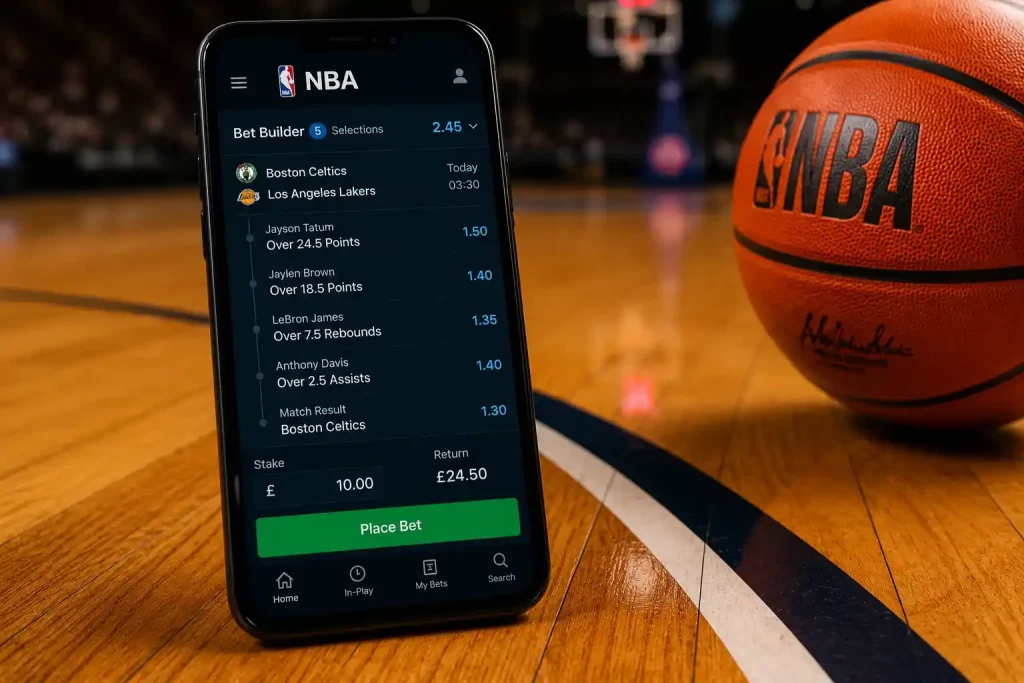
The Slip Behind the Slip
A friend showed me his Bet Builder slip in March – eight legs, 47.0 decimal, all on a single Lakers game. He’d built it in three minutes. I asked him what the implied probability was. He laughed. I asked him what the hold percentage on the ticket was. He stopped laughing. The answer was somewhere north of 22%, and he’d built that ticket because the operator’s interface had nudged him gently toward more selections with every tap.
The Bet Builder market is the most profitable product UK operators have launched in the last decade. Bet365’s NBA market depth of 140+ markets per game and Unibet’s 50+ per game both exist primarily to feed Bet Builder consumption. The product converts modest-margin singles into high-margin combination tickets, and basketball – with its huge prop variety and natural correlation between outcomes – is the perfect sport for it.
What the operator’s product team won’t tell you, because there’s no incentive to: the rules around selection caps, the cash-out maths, the hidden hold layered on top of each leg, and the operator-by-operator nuances that determine whether a Bet Builder is a fair bet or a slow drain. The UK Gambling Commission’s chief executive Andrew Rhodes has been blunt about the wider context, saying It’s not for the Commission to be engaged in a moral debate about gambling. We’re here to licence it and regulate it. Our obligation is to aim to permit gambling providing it’s in line with the licencing objectives.
What that translates to in practice is that the operator can structure these products however the commercial team wants, as long as the rules are disclosed. The rules are disclosed. They’re just buried in pages no one reads.
See also NBA cash out mechanics for managing your bet builder.
How the Builder Engine Prices Your Slip
The Bet Builder isn’t a true accumulator. It’s a single bet on a combined outcome, priced by the operator’s correlation model. When you select a Lakers spread, Anthony Davis points, and LeBron James assists, the algorithm runs a Monte Carlo simulation across millions of possible game states, calculates joint probability, and quotes you a single decimal odds price.
The naive view – “if each leg is 50% likely, three legs should be 12.5% likely, so the price should be 8.00” – is almost never what you see. The operator’s model factors in correlation. Three legs on the same team’s success are positively correlated (joint probability higher than naive). Three legs mixing favourite team success with opponent player Overs are negatively correlated (joint probability lower than naive). The algorithm prices either way down toward the operator’s margin.
The hold gap between naive multiplication and operator price is the Bet Builder’s profit centre. On a two-leg correlated builder, the difference might be 6-8%. On a five-leg builder, 15-18%. On a ten-leg builder, 25-30%. The product is engineered so that every additional leg adds operator margin. That’s not a bug – it’s the design.
One nuance British punters miss: the algorithm rounds toward operator-friendly prices. A model output of 4.73 will display as 4.50 or 4.75 (rounded down to nearest decimal step), never 4.75 (rounded up). Across thousands of slips per day, that rounding adds up to material operator revenue. The maths is consistent: the algorithm tells the truth, the interface rounds in one direction.
Selection Caps and Why They Exist
Bet365 supports up to 12 selections in a single NBA Bet Builder. Unibet supports 10. Sky Bet caps at 8. Paddy Power caps at 8 with frequent expansions on featured games. The cap isn’t an accident – it’s the operator’s risk management threshold.
Why caps differ: smaller operators have less modelling capacity to handle the combinatorial explosion of high-leg builders. A 12-leg builder requires the algorithm to evaluate roughly 4,000 possible correlation combinations per ticket. A 6-leg builder needs only 64. The smaller operator’s model is faster and more conservative; the larger operator’s model is more sophisticated and accepts more selections.
The cap also reflects integrity risk. A 12-leg builder on a single NBA game with deep-bench player props is the exact structure that prop-manipulation schemes (like the Jontay Porter case) have exploited in the US. UK operators caps on builder size partly reflect the regulatory environment – keeping the product within bounds the operator can monitor for unusual betting patterns.
For the punter, the cap matters because hitting it forces a choice. If you’ve built a 12-leg slip at Bet365 and can’t add a thirteenth selection, you’ve reached the operator’s risk limit. Crossing operators to add the thirteenth means breaking the bet into two slips, which removes the correlation pricing entirely – each slip is now priced independently. The cumulative hold often improves slightly versus a single 13-leg slip, but you’ve also lost the parlay payoff structure.
UK Gambling Commission data shows 8,234 licensed gambling premises operating in Great Britain in 2025 – down 1.1% year on year. The licensed online market is where the Bet Builder lives, and the operator licence comes with disclosure obligations. The selection cap is one of the few rules that’s typically posted plainly in the help section. Read it before building.
Cash-Out on a Bet Builder: Convenient or Costly
Most UK operators offer cash-out on Bet Builder tickets – the option to take a smaller, immediate payout in exchange for closing the bet before all legs resolve. The interface presents this as flexibility. The maths usually presents it as cost.
How cash-out is priced: the operator’s algorithm calculates the current probability of all remaining legs hitting, multiplies by your original payout, and offers you that figure minus a cash-out margin. The margin runs 5-12% on Bet Builders, on top of the original ticket’s hold. So a £100 stake at 8.0 decimal (potential £800 return) that the model says is now 60% likely to fully cash should mathematically be worth £480 – but the cash-out offer is typically £400-£430. That gap is the operator’s second cut.
When cash-out makes sense: when you’ve already won enough legs that the remaining outcome is purely high-variance (a buzzer-beater requirement, a late-game prop with thin margin), and the cash-out value exceeds 70-80% of your potential return. The variance protection is real. When cash-out doesn’t make sense: when the offer is below 60% of potential return – the operator is pricing you out of fair value and you should hold for the variance.
The psychology trap I see most often: punters cash out winning Bet Builders at 30-40% of potential return because “a small win is better than risking the loss.” Mathematically, on a high-leg builder where most legs have already hit, that’s almost always the wrong choice. The remaining legs typically have higher implied probability than the cash-out fraction suggests. The operator profits from punters who treat cash-out as risk management without checking the price.
The Hidden Hold Layer
I run an exercise with the punters I coach. Take any Bet Builder slip you’ve ever placed. Calculate the implied probability of each leg from its single-bet price. Multiply them naively. Compare to the actual Bet Builder price. The gap is the hold.
Sample slip: Lakers -5.5 (1.91), Lakers Over team total 112.5 (1.91), LeBron James Over 7.5 assists (1.95). Naive parlay: 1.91 × 1.91 × 1.95 = 7.11. Operator’s Bet Builder price: 4.40. The hold is enormous – the operator has reduced the payout by 38%, even though the legs are correlated and the joint probability is genuinely higher than naive multiplication.
Why so much hold? Because the operator’s correlation model has flagged that all three legs are pointing in the same direction (Lakers win comfortably) and concluded that the joint probability is much higher than naive – maybe 30-35% rather than the 14% naive suggests. They’ve priced the slip to roughly 28-30% implied probability (1 ÷ 4.40 = 22.7%), keeping the entire correlation lift as operator margin.
What the punter can do about this: compare the operator’s Bet Builder price to two separate single-leg parlays at smaller operators. A standard two-leg moneyline-plus-spread parlay at Bet365 might price at 5.20 versus the Bet Builder’s 4.40 on the same legs – because the standard parlay doesn’t have the correlation adjustment baked in. Knowing when to use the Bet Builder versus the standard parlay slip can save 15-20% on the ticket price for the exact same selections.
One last piece: the operator’s correlation model is conservative. It tends to assume more correlation than actually exists in the underlying data, because that’s the operator-friendly assumption. Empirical correlation between Lakers winning by 6+ and LeBron getting 8+ assists is positive but smaller than the model treats it. The punter who recognises that the model over-prices correlation can occasionally find genuine value on Bet Builders that include legs the model treats as more correlated than they are.
Which UK Books Handle NBA Builders Well
Bet365 leads on depth – 140+ markets per game gives the Builder engine the widest possible inventory to combine. The correlation model is sophisticated, the rounding is operator-friendly, and the cash-out is competitive but not generous. The hold is high on multi-leg builders, but the line variation across the available selections sometimes creates value if you shop within the same game.
Unibet runs around 50+ markets per game, with builder support up to 10 legs. The correlation model is less aggressive than Bet365’s, which means slightly more generous pricing on some correlated combinations – but the smaller market inventory means you’re often forced to use selections you wouldn’t pick at single value.
Smaller UK operators with under-30 markets per game typically run weaker correlation models, which can mean better pricing on certain builds but limited inventory. Mid-sized operators like 10Bet (acca calculator embedded in the slip) and Coral (loyalty-based price boosts) offer occasional promotional improvements on Bet Builder pricing that can shift the long-run EV.
What I tell UK punters new to the market: have accounts at three or four operators, build the same slip at each one before clicking, and take the best price. The variation can be 20-30% on the exact same selections across operators. That’s a huge edge available without any modelling work – just two minutes of comparison shopping per ticket. If you want to compare the Builder hold to the cash-out structure for the same kinds of slips, my walkthrough of cash-out mechanics for NBA bets in the UK goes through the per-operator differences in more detail.
See also nba betting help for the complete NBA betting guide.
Walking Off the Builder Slate Cleanly
The Bet Builder is one of the operator’s best products and one of the punter’s most expensive habits. Used sharply – two or three correlated legs, on a single game, at the best available price across UK books – it can generate marginal positive EV. Used casually – eight legs of mixed-correlation guesses, accepted at the first operator’s quoted price, cashed out at 30% of potential return – it’s a slow drain. The product itself is neutral. The clicks you make on it are what determine whether it pays for your weekend or for the operator’s next yacht. Choose the clicks accordingly.
At most major UK operators, yes - cashing out a Bet Builder placed with a free-bet token usually voids any associated bonus structure or limits the qualifying period for the next free-bet offer. The specific rules vary by operator and by promotion, but the general pattern is that cash-out is treated as a settled bet and bonus systems track settlement, not original stake. If a Bet Builder was placed with a deposit-match bonus, cashing out can reset the wagering requirements progress or zero them entirely. Read the promo terms before clicking cash-out on a bonus-stake ticket. The cap reflects three things: the operator's modelling capacity for correlation across many legs, the operator's risk management threshold for high-variance tickets, and the regulatory environment around integrity monitoring. Smaller operators with limited model complexity cap at 6 because the algorithm can handle the combinatorics. Larger operators with sophisticated models extend to 12 because they're confident in pricing the higher-leg slips. The cap is rarely a binding constraint for most UK punters - anything beyond four or five legs is high-variance entertainment, not a strategic position.Frequently Asked Questions
Does cashing out an NBA Bet Builder forfeit free-bet eligibility?
Why do some UK books cap NBA Bet Builders at 6 selections?
