
Cashing Out NBA Bets in the UK: When the Offered Number Hides a Tax
 Available in US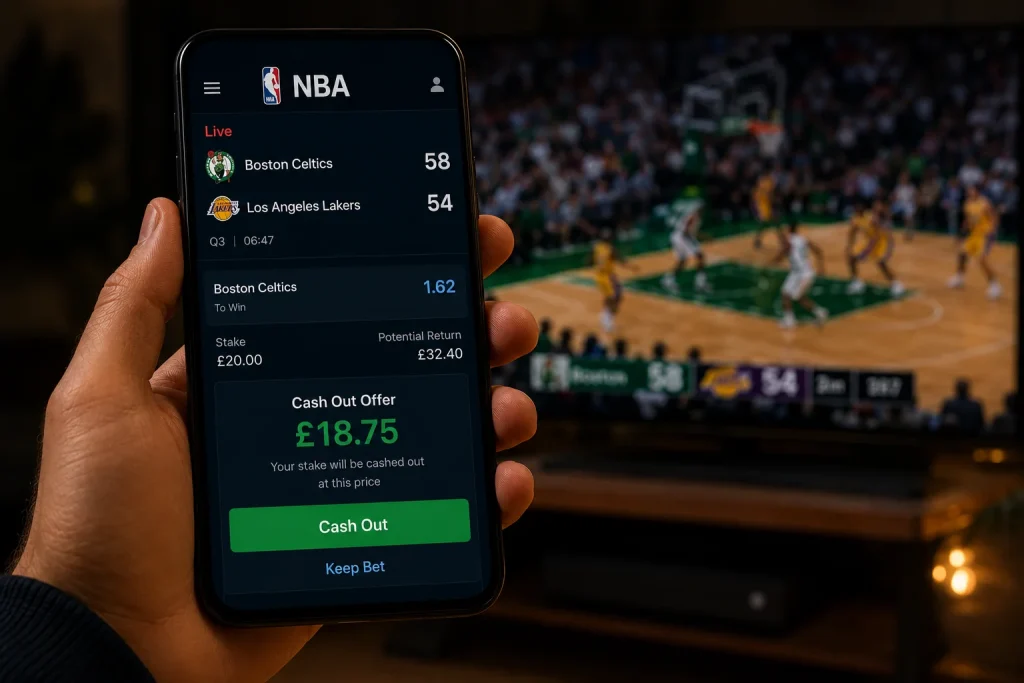
The Button That Costs You Money
UK online real-event betting GGY in Q4 of the 2024-25 financial year hit £596 million – up 5% year on year. A meaningful portion of that growth came from cash-out conversions on live and pre-event markets, where punters take partial settlement before the bet would naturally resolve. The product is marketed as flexibility. The maths often tells a different story.
Cash-out is the single most lucrative feature an operator has invented since the Bet Builder. The mechanic is simple: at any point during a live event, the bookmaker offers you a number that closes your bet immediately. Hit the button, take the cash, walk away. The convenience is real. The cost is real too, and most UK punters who use the feature regularly have no idea how it’s priced.
I want to walk through the structure: how the cash-out price is generated, when partial cash-out beats full cash-out, the live-NBA cash-out variations specific to British operators, and the psychological pressure that makes the button so hard to resist when a ticket is teetering between cashable and dead. By the end you should be able to look at any cash-out offer and tell me whether it’s a gift or a tax.
See also NBA live in-play betting for real-time cash out use.
How the Cash-Out Number Is Built
Every cash-out offer starts with the bookmaker’s current live probability estimate of your bet winning. If the operator’s model says your Lakers -6.5 ticket placed pre-game at decimal 1.91 now has a 65% chance of cashing (the Lakers are up by 10 with 4 minutes left), the fair value of the bet right now is your potential return (1.91 × stake) multiplied by 0.65.
On a £100 stake at 1.91, your potential return is £191. The 65% live probability puts the fair current value at £124. That’s the number the operator’s model spits out before any margin is applied. What you actually see on the cash-out button is typically £108-£115. The difference – £9 to £16 in this example – is the cash-out margin the operator takes on top of the underlying bet’s hold.
Cash-out margins on NBA bets at UK operators typically run 5-12%. Bet365 and the larger UK books tend toward the lower end of that range on standard bets. Smaller operators and on more complex tickets (Bet Builders, multi-game accumulators) the cash-out margin can push 15-20%. Always remember: the cash-out offer is the operator’s price, not the fair price.
One subtlety British punters miss: cash-out is offered on losing bets too. If your Lakers ticket is on the brink and the bookmaker offers £8 cash-out on a £100 stake, you’re being asked to settle a near-losing position for 8% of stake. The fair value at that point might be £5 or £15 – you don’t know without doing the maths. Taking £8 might be a gift; it might be a tax. The operator knows which one. You usually don’t.
Partial Cash-Out: Hedging Without Closing
Partial cash-out lets you settle a portion of your bet now and let the rest run. You select what fraction of your stake to cash out – 25%, 50%, 75% – and the operator pays out a proportional share of the current full cash-out value. The remaining portion stays as an open bet, settling normally when the event ends.
The maths is identical to full cash-out, just applied to a fraction. If full cash-out value is £108 on a £100 stake at 1.91, a 50% partial cash-out pays £54 now and leaves £50 of stake running at 1.91. You’re locking in £54 of guaranteed value and keeping potential upside on £50 worth of stake.
When partial works well: when you’ve identified that your bet has moved into the “likely cash” zone but not “certain cash” zone, and you want to protect a portion of the upside without giving up the variance. A pre-game Lakers -6.5 now up by 9 with 3 minutes left isn’t certain to cover (a few quick threes from the trailing team can wreck it), but it’s likely. Partial cash-out at 50% protects half your potential return while leaving you exposed to the favourable variance.
When partial doesn’t work: when you’ve panicked. Partial cash-out is often used by punters who can’t decide between holding and cashing, so they compromise. That’s a psychological choice, not a mathematical one. The 50/50 split is rarely the optimum stake allocation – usually either holding 100% or cashing 100% is the EV-correct play, depending on where the fair value sits relative to the offer.
The cleanest use case I see: a long-leg Bet Builder where five of seven legs have cashed and two remain. Partial cash-out at 40% of value locks in some guaranteed profit while leaving exposure to the high-variance final legs. If both remaining legs hit, you get the upside. If they don’t, you’ve at least secured something. That’s the textbook use case the operator’s product team imagined when they built the feature.
Live Cash-Out: The Highest-Hold Moment
Live cash-out on NBA bets carries the widest margins because the underlying bet is the most expensive to price. The bookmaker’s algorithm is running real-time probability updates on a fast-moving game, factoring in score, time remaining, possession, foul situation, and recent shot quality. Each update adjusts the cash-out value.
The live NBA market handle in the United States hit a combined sport-betting total of $166.94 billion in 2025, and a significant share of that handle flowed through live markets – the format that produces the most cash-out conversions. The volume is enormous, and the operator’s margin on live cash-out is one of the highest-yield products on the entire betting card.
What the live cash-out hides: the operator’s model adjusts faster than the broadcast feed reaches your screen. Prime Video’s UK NBA feed runs with a 5-25 second delay versus the bookmaker’s data source, depending on the operator’s data provider. By the time you see a made three-pointer that should swing the cash-out value upward, the operator has already adjusted the offer. You’re chasing the algorithm with a delay.
The clean live cash-out spots: when your bet is well ahead of the fair price (the operator’s offer is generous because they want to close exposure quickly) and when the live game state has stabilised (a 15-point lead with 2 minutes left, where variance is genuinely low). The dirty spots: when your bet is on the brink, you’re watching with a feed delay, and the cash-out value keeps dropping every 10 seconds. That’s the operator’s profit moment – you’re more likely to click out of panic than out of analysis.
The Psychology Trap Behind the Button
UK punters take cash-out offers at well below fair value because cashing out feels like winning. The brain rewards converting risk into certainty, even at a mathematical loss. Operators know this; the entire product design is built around the dopamine of clicking and seeing a guaranteed number in your balance.
The behavioural pattern I see most often: a punter is up on a bet, the cash-out offer is well below fair value, but the punter has been burned by past losses. Memory of the bad beat overrides the maths. They click. The cash-out value of £67 on a fair-value £85 ticket goes into the balance, the bet resolves at the full £85 fifteen minutes later, and the punter laments. Next time, the same scenario produces the same click.
The opposite pattern is worse: a punter is losing on a bet, the cash-out offer is at 30% of stake, the punter takes it to “save something.” The maths might say the bet has a 45% chance of cashing fully, which means the fair cash-out value is higher than 30%. The punter has converted a positive-EV holding pattern into a negative-EV early settlement, all because the panic of watching the bet lose overrode the patience to let it run.
The discipline I drill in: never click cash-out without spending 30 seconds doing the implied probability check. Convert the offer to a percentage of potential return. Compare to your honest estimate of the bet’s remaining win probability. If the offer is below your honest estimate, hold. If above, take it. The discipline is simple; the execution under emotional pressure is brutal.
How UK Operators Differ on Cash-Out
Bet365 was an early adopter of cash-out and its margins are typically the tightest on standard NBA singles – 4-6% margin on top of the underlying bet’s hold. Their live cash-out updating speed is among the fastest in the UK market. Cash-out on Bet Builders is more expensive but still competitive versus smaller operators.
Sky Bet’s cash-out values tend to run 7-10% margin on singles, often offering slightly worse value than Bet365 but with a simpler interface. The cash-out option appears prominently on all live bets and the partial cash-out slider is well designed for the casual punter.
Smaller UK operators – the ones with thinner NBA modelling – often run cash-out margins of 10-15% on singles and 15-20% on builders. The bigger margin reflects the operator’s lower confidence in their live model. From the punter’s perspective, those operators offer cash-out as a product but rarely deliver fair value. If you’re going to use cash-out regularly, account-stack at the operators that price it most aggressively.
Betting exchanges work differently. On a layback position (where you’ve laid a bet you also backed earlier), you can effectively “cash out” by placing a counter-bet on the other side at current market prices. The exchange doesn’t charge a cash-out margin – the cost is the spread between back and lay prices, which is typically much tighter than an operator’s cash-out margin. For sharp punters who want flexibility without operator markup, the exchange route on NBA bets is mathematically superior. The catch is liquidity – exchange NBA markets are deep on top-tier matchups but thin on midweek games, where the back/lay spread can widen to 5-8 percentage points. If you want to extend the live-bet thinking into broader in-play strategy, my deeper writeup on NBA live and in-play betting in the UK covers the timing and stream lag in more detail.
Walking Away Without Walking Into the Tax
Cash-out is a tool, not a strategy. Used sharply – with the maths checked, the variance situation understood, and the operator’s margin priced in – it can lock in genuine value when your bet is in a favourable zone. Used casually – clicked out of panic, accepted at the first quoted number, treated as a substitute for analysis – it’s a slow drain on every winning streak you’ll ever have. The button is convenient. The maths behind it is not. Treat every click as a settlement decision, not a relief decision, and the cash-out market stops being the operator’s profit centre and starts being a part of your actual betting toolkit.
See also nba betting help for the complete NBA betting guide.
Yes, but rarely. The mathematical condition: the cash-out offer must exceed the bet's true expected value given current game state. On a Lakers -6.5 ticket where the team is up 12 with 90 seconds left, true win probability might be 92%. Fair cash-out value on £100 at 1.91 is £176 (92% of £191). If the operator offers £180, that's +EV cash-out. Bigger offers happen when the operator wants to close exposure during a market suspension or when their model genuinely runs above the public estimate. Most cash-out offers are below fair value, which is why the product is profitable for the operator. Exchanges don't offer a 'cash-out' button in the operator sense. What they offer is the ability to place a counter-bet on the opposite side at current market prices, which produces a similar effect - your back and lay positions net out to a guaranteed result. The cost is the bid-ask spread on the market, not a built-in operator margin. On a liquid NBA matchup at Betfair, the spread might be 0.02 in decimal odds, which is much tighter than a typical operator's cash-out margin of 5-12%. On a thin midweek market, the spread can widen to 0.10-0.15, which approaches operator-margin levels.Frequently Asked Questions
Is cashing out a winning NBA bet ever +EV?
Do UK exchanges offer cash-out on NBA layback positions?
