
Prop Bet Integrity in the NBA: Sportradar’s 233 Flags and the Jontay Porter Case
 Available in US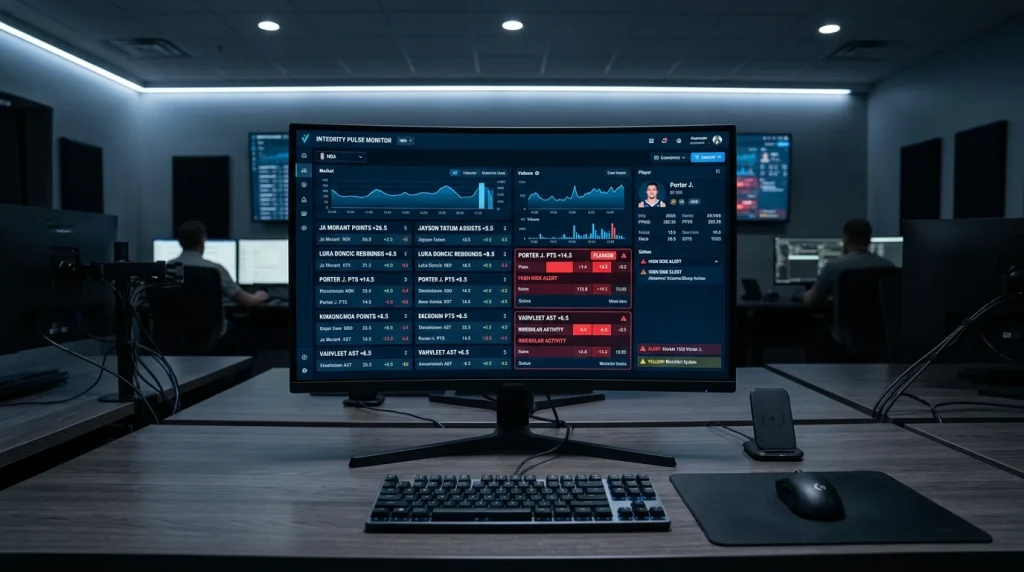
The Phone Call That Made Me Stop Backing Niche Props Cold
March 2024. A friend who works on the trading floor of a UK book rang me about a player I had been backing on rebound under markets. Not a star, not a household name – a rotational big whose minutes had been creeping up. The book was pulling his props off the board. They would not say why. Two weeks later the Jontay Porter story broke and I understood the call. The pattern that had looked like a value angle to me had looked like something else to people watching every market simultaneously.
The Porter case changed how I think about prop bets at the bottom of the rotation. Not because every niche prop is suspect – most are not – but because the infrastructure now watching these markets is faster, more comprehensive, and more punishing than it was even three years ago. The mental model needs updating.
See also NBA betting UK regulation for integrity safeguards.
The Monitoring System That Sees Every Market Simultaneously
Sportradar’s integrity services unit operates a real-time monitoring system that tracks betting markets across thousands of operators in dozens of jurisdictions. The system flags unusual betting patterns – sudden volume on niche markets, line movements that exceed model predictions, correlated betting across multiple books on related markets, and any market activity that does not match the underlying sporting context.
In 2025, the system flagged 233 suspicious basketball matches globally. Football flagged 618 over the same period, partly because football has many more lower-tier matches that are easier to manipulate. The basketball figure is dominated by lower-tier European leagues and college games, but the NBA has had its own series of flagged incidents – most public among them the Porter case in 2024.
What makes the system effective is not the flagging itself but the speed. A flag goes to integrity officers within hours of the unusual pattern. The relevant operator is notified. The league is notified. The bets in question are often pulled before settlement. The chain that runs from suspicious activity to consequence is now measured in days, not months.
The 233 Flags in Context
233 flagged basketball matches across the global market in a year is a number that needs context. The total volume of basketball matches monitored runs into the tens of thousands annually – NBA, EuroLeague, NCAA, plus all the smaller leagues. The flag rate is well under one percent. Most flags resolve as false positives – unusual but explainable activity. A minority become formal investigations.
Among the 2025 flags, the NBA share is smaller than the volume might suggest. The league’s relationship with regulated US sportsbooks since 2018 has created a transparency layer that makes manipulation harder. The data flowing in both directions – book to league, league to book – makes pattern matching faster than in less integrated markets. Adam Bjorn, working on integrity infrastructure at Plannatech, summed up the deterrent effect in late 2024: The deterrent is more eyes watching, and the players and the refs have more caution.
That is the whole game in one sentence.
The lower-tier leagues – second-tier European, college, lower-profile international – carry more of the flagging weight. They have less centralised media coverage, smaller official observation footprints, and more financial pressure on individual participants. The NBA is not immune, but the structural protections are stronger than in any other basketball jurisdiction.
The Porter Timeline and What It Revealed
The Jontay Porter case unfolded over the 2023-24 season. Porter, a rotational player for the Raptors, was flagged after his under-on-multiple-stats props attracted unusual betting volume on at least two specific games. The pattern was that Porter would exit games early – citing injury or illness – in a way that locked the under bets on his prop lines. The financial structure suggested coordination with bettors who knew the early-exit pattern.
The league investigated through the spring of 2024. Porter received a lifetime ban in April 2024 – the first NBA player banned for gambling-related conduct since the 1950s. The investigation made public the mechanics of how the flagging system worked, how the league cooperated with US regulators, and how quickly the chain from suspicious activity to consequence ran.
What the case revealed at the betting level was the asymmetry on niche props. Star player props on five-figure handles attract scrutiny but are hard to manipulate because the player is on the court too much. Bench player props on lower handles are easier to influence but more visible in the monitoring data because the volume is unusual. The middle band – sixth, seventh, eighth man rotations with consistent minutes – is where the most flags have historically clustered.
UK Implications and How Books Handle It
UK books took the Porter case seriously. Bet365, which offers 140-plus markets per NBA game, tightened its prop offering on rotational players for the 2024-25 season. Limits on niche player props were reduced. Volume thresholds for opening markets were raised. Some books quietly stopped offering certain prop categories on players outside the top six in the rotation.
For the UK punter, the practical effect is that prop limits are smaller than they were two years ago, particularly for under bets on rotational players. The reduced limits are not arbitrary – they reflect the books’ assessment that the asymmetric information risk on these markets justifies tighter caps. The flip side is that legitimate bets on niche player props face friction that did not exist before. The cost of integrity is some friction for honest punters.
The other UK-relevant change is in void rules. Books are more willing to void prop bets when a player exits a game in a way that triggers integrity concerns – even if the exit appears legitimate at the time. The void typically applies to all bets on that player’s props for that game, regardless of whether the bet was placed before or after any flagging. The risk for UK punters is that a bet placed in good faith can be voided weeks later if the league subsequently determines integrity issues were involved.
What to Avoid in the Current Environment
The clearest rule I follow now is to avoid building parlay positions around props from rotational players on cellar-dwelling teams. The combination of low team incentive, low player profile, and bench-rotation minutes is the highest-risk profile for prop bet voids and integrity flags. Even if the underlying bet is sound on the numbers, the volatility risk on settlement is too high to justify the value capture.
The second rule is to avoid the under on minutes-restricted players. The Porter pattern was an under play – exit the game, lock the under. The books and the league watch under-on-minutes-restricted-players with particular care. Even if the line is genuinely soft, the friction on settlement is higher than the value justifies for most positions.
What is still safe and value-rich is star player props on standard markets – points, rebounds, assists, threes. The volume on these markets is too large to manipulate. The audit trail is too extensive. The skill component dominates. The vast majority of profitable UK NBA prop play sits in this middle zone – the top six players on rotation, the standard prop categories, the well-trafficked markets where the books have priced for sharp action and the public action is the dominant counterparty.
The Self-Imposed Rules That Keep the Account Healthy
Beyond the league and book restrictions, the discipline that has served me well is treating prop markets like a tiered system. Top tier – star player props on standard categories. Middle tier – second-tier rotation players on standard categories. Bottom tier – niche markets on rotational players. I size bets descending through the tiers. Top tier gets full position size. Middle tier gets half. Bottom tier I avoid entirely outside of specific situational reads where the value is overwhelming.
The under-discussed cost of bottom-tier prop activity is the customer profile it creates. Books track betting patterns across markets. A customer who concentrates on bottom-tier niche markets gets flagged not for cheating but for being the kind of account that might be involved in something the book wants to avoid. The friction on cash-outs, account limits, and bet acceptance can rise even for honest punters who focus too heavily on the most fragile market segments.
The reading on referee patterns is a related part of the integrity infrastructure – the same monitoring systems that watch player markets watch officiating data, and the analyst-level work on crew tendencies and the L2M report sits in the same data ecosystem as the prop monitoring described above. Treating either as isolated misses the picture.
The prop bet market is healthier than it was three years ago because of the monitoring infrastructure. It is also more constrained for the punter, with smaller limits, tighter rules, and more friction on niche markets. The trade-off is worth it – the alternative is a market where the Porter case becomes routine. The discipline is in playing inside the constraints while still finding the value the books leave on the table in the well-trafficked categories.
See also nba betting help for the complete NBA betting guide.
Most UK books reserve the right to void prop bets if the league subsequently determines integrity issues affected the game. The void typically applies to all prop bets on the player in question for the relevant game, regardless of when the bet was placed. This is an unusual rule because it can void bets placed in good faith weeks before any flagging occurs. The risk is small but non-zero, and it concentrates on rotational players on cellar-dwelling teams more than on star players on contenders. EuroLeague is monitored through the same Sportradar integrity infrastructure but with somewhat less coverage depth than NBA. The 233 flagged basketball matches in 2025 included EuroLeague, lower European tiers, and NCAA alongside NBA, and the lower tiers carry a disproportionate share of the flags. The NBA's media transparency and the US regulated betting market structure provide additional layers of detection that less integrated leagues do not have. The implication is that EuroLeague prop markets carry slightly higher integrity risk than NBA props, even on similar player profiles.Frequently Asked Questions
Do UK books void prop bets if a player is later flagged for an integrity investigation?
Does Sportradar monitor EuroLeague basketball with the same intensity as NBA?
