
The NBA Injury Report for UK Bettors: A Daily Workflow Before Tip-Off
 Available in US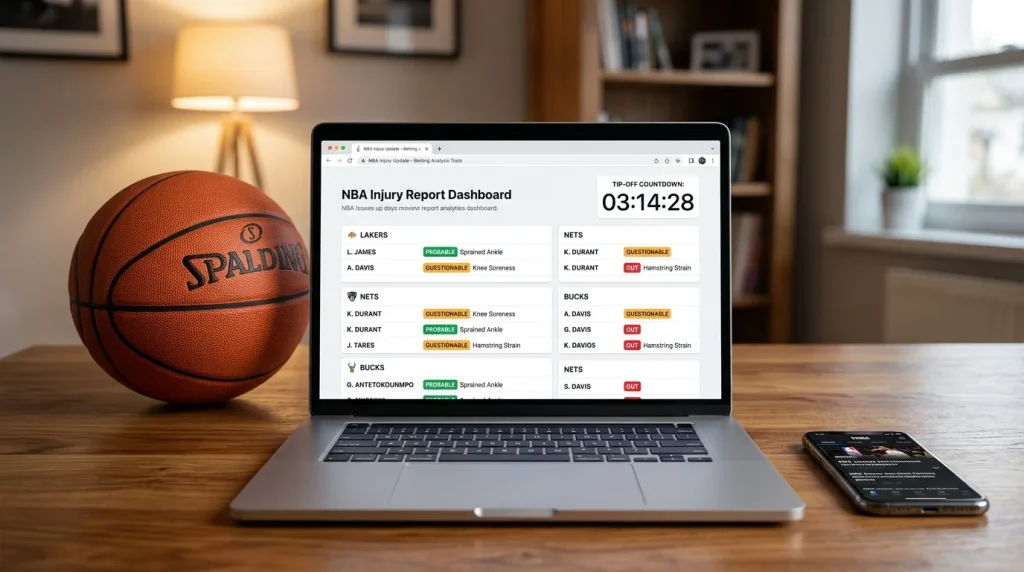
The Night I Lost a Stake to a Status Change at 11:43pm UK Time
A Monday in January 2024. I had backed a player props parlay built around a Bucks starter at decent juice. Tip-off was 12:30am UK time. At 11:43pm, the official injury report updated. Status changed from “questionable” to “out.” My bet was still live – the books had moved the lines, but my pre-priced ticket stood. By tip-off the prop I had backed was effectively worthless. The stake was gone before the ball was tipped.
That night taught me that the NBA injury report is not just information. It is a clock. The clock runs faster than UK punters typically watch it, and the books read the clock faster than we do. The difference between being on the right side of an injury update and the wrong side is sometimes 45 minutes – and almost always less than two hours.
See also late scratches for UK bettors and their timing impact.
How the Report Actually Updates Through the Day
The NBA mandates that teams submit injury reports at three points before each game: 5pm Eastern Time the day before, 5pm Eastern Time the day of the game, and one hour before tip-off as a final status update. Translated to UK time during winter daylight savings, that is roughly 10pm UK time the day before, 10pm UK time the day of the game, and one hour before tip-off – which lands anywhere from 11pm to 4am UK time depending on the slate.
The status tags themselves are standardised. “Out” means the player will not play. “Doubtful” means roughly 25 percent chance of playing – in practice, more like 15 percent. “Questionable” means roughly 50 percent. “Probable” means roughly 75 percent. “Available” means they will play barring something unusual.
The crucial point is that these labels are not random guesses. The league enforces them with fines for teams that mislabel – particularly the “questionable but actually playing” pattern that used to be common before the participation policy. Teams are now required to disclose load management rest as load management rest, not as “non-COVID illness” or other dodge. That makes the labels more readable than they were five years ago.
What Each Status Actually Means for Your Bet
Treating injury report labels as the literal probabilities the league publishes will lose you money. The implied probabilities are correct in expectation across the season, but they vary sharply by team, coach and game context. A “questionable” star on Steve Kerr’s roster has historically played about 65 percent of the time when listed. A “questionable” star on certain Eastern Conference rosters plays closer to 35 percent. The coach-by-coach variance is real and worth tracking.
Game context matters too. A “questionable” star against a top-five seed in a nationally televised game is more likely to play than the same star against a 14-seed on a Tuesday. The body of evidence on this is consistent – coaches play their stars when it matters. UK books factor this into their lines but the public does not always.
The other reading is the pattern. A player listed as “questionable” three games in a row, with the same injury, is signalling something. The first listing is usually true 50-50. The third listing in a week is almost always a coach managing minutes – the actual probability of playing is closer to 70 percent. Repeat questionable status is bullish, not bearish, on the player suiting up.
Why Late UK Tip-Offs Make This Worse
The 45-minute window between final status updates and tip-off is when most last-minute moves happen. For a 7:30pm Eastern tip-off, that window is 1:30am to 2:15am UK time. For a 10pm Eastern Pacific tip, it is 4am to 4:45am UK time. The UK punter who placed bets at 9pm UK time the previous evening has no realistic way to monitor the final update before sleeping.
This creates a structural disadvantage that I have not seen any clean fix for. The two viable approaches are: bet earlier in the day with full acceptance that late scratches may void or settle awkwardly, or bet much later – within 90 minutes of tip-off – with most information already public. The middle approach, betting around 9pm to 10pm UK time the day of the game, is the worst of both worlds. You have committed to a price before the second injury report drops, but you have no way to react to it.
Around 95 percent of UK online betting is done from home, and 76 percent of 18-24 year-olds bet on mobile. The mobile reality is that push notifications from the books can hit your phone at 1am UK time with line changes you cannot do anything about. The discipline is in not opening the app at 1am to make a panic adjustment. The disciplined position is set the bet, accept the outcome, sleep.
How Late Status Changes Move the Pace Math
Injury reports do not just move spreads and player props. They move the pace projection for the entire game. The league averaged 99.4 possessions per 48 minutes last season, with Boston at 96.45 as the slowest team. When a primary playmaker goes out, the team’s pace usually drops – not because the coach changes scheme, but because the backup creates less, takes longer to set up offence, and produces more late-clock shots.
A 4-possession drop in pace, which is what a primary playmaker absence often causes, translates to roughly 8 to 12 fewer points in the total. UK books move totals quickly on stars-out news. The window where the line moves but the total has not fully repriced is usually around 30 to 60 minutes after a status change. That is the live betting window worth watching if you are awake for it.
The under-appreciated angle is the opposing team’s pace. A team that wants to run sees the playmaker’s absence as licence to push. The total can move down because of the absence and back up because of the opposing pace push. Reading the second-order effect is the difference between a sharp pace bet and a public reaction bet.
The Tools and Feeds I Actually Use
The NBA’s official injury report is the source of truth, but it is updated at three discrete times. For real-time monitoring, beat reporter Twitter is faster than any aggregator. Shams Charania and Adrian Wojnarowski both break status news ahead of official updates routinely. I have a UK-aware list of about a dozen beat reporters whose feeds I check at 1am if I have a live position.
The aggregator services – RotoWire, Lineups, FantasyAlarm – are useful for the day-of summary but not for real-time. They typically lag the underlying reporter feeds by 5 to 15 minutes. For a UK punter who is awake for the late tip-off window, going direct to the reporter source is faster.
The compliance and integrity angle here is increasingly important. Sportradar flagged 233 suspicious basketball matches in 2025, compared to 618 in football, and player-status irregularities are part of what their monitoring catches. Adam Bjorn at Plannatech, talking about the visibility regulated markets create, put it cleanly in late 2024: The deterrent is more eyes watching, and the players and the refs have more caution.
The same visibility applies to injury reports – late status changes that move betting markets are tracked, and the league prosecutes the patterns aggressively now.
The Pre-Tip Five-Minute Check That Saves Stakes
My discipline before placing any NBA bet within 90 minutes of tip-off is a five-step check. Confirm the latest injury report on the official NBA site, not the aggregator. Cross-reference with the relevant team beat reporter’s feed for the last two hours. Check the bookmaker’s stated rules on late scratches and prop void for the players involved. Look at the line movement in the last 30 minutes for confirmation of public versus sharp action. Then place.
If the bet is more than 90 minutes from tip-off and I cannot stay awake for the late update, I either size down or skip. Size adjustment is the under-discussed part of injury report discipline. A bet at half stake survives a bad scratch with half the damage. Sometimes that is the difference between a profitable week and a week of churn.
For the punter who keeps getting caught by 4am scratches, the cleanest single fix is a UK-specific late scratch playbook that covers void rules across the major UK books and the time-zone-aware monitoring patterns that work for someone not staying awake for the tip-off itself. The injury report and the scratch protocol are two halves of the same problem.
The injury report is the most consequential piece of information in any NBA bet you place. Treat it as the live document it is, watch the clock not the headline, and the late-night status update stops being the enemy.
See also nba betting help for the complete NBA betting guide.
The league requires a final status update one hour before tip-off, and that is the cutoff for official report changes. However, unofficial information - beat reporter scoops, team source confirmations - can leak in the final 45 minutes and routinely does. UK books continue to adjust lines until tip-off itself, but any change inside the one-hour window is the most volatile period of the betting day. Bets placed before that window are locked at the price you took, and late scratches are then subject to the book's specific void or settle rules. UK books continue adjusting lines until tip-off, but the pace of adjustment slows after the one-hour pre-game final report. Between the final report and tip-off, lines mostly hold unless a beat reporter breaks news of a late scratch. Inside the last 15 minutes before tip, some books pause markets briefly to absorb final inactives. The window where price still moves but is increasingly thin on liquidity is typically 30 to 45 minutes before tip-off - that is when the sharp action lands and the line shape stabilises.Frequently Asked Questions
How late before tip-off can an NBA team officially change a player's status?
At what point during NBA injury-report updates does a UK book's price stop adjusting?
