
NBA Live and In-Play Betting in the UK: Triggers, Lag and Real-Time Math
 Available in US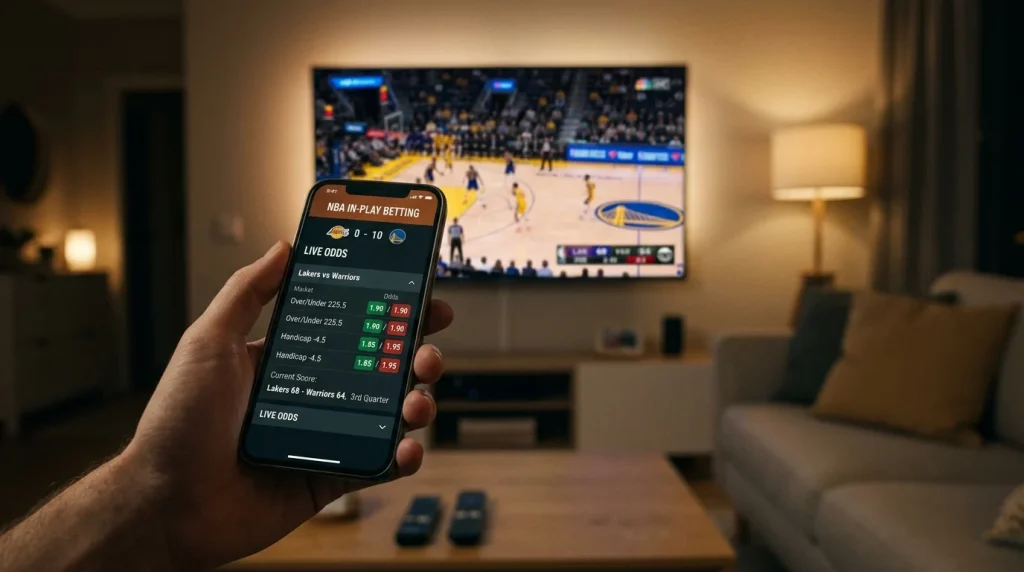
The Twenty-Second Disadvantage
The first time I tried to play live NBA on a UK book during a Prime Video broadcast, I watched a buzzer-beater three drop on my screen, hit refresh on the betting app, and found the live odds had already moved. By the time I clicked, the price had updated again. I lost twice – once because I was late, once because I was confused about which version of the score I was looking at. That was the moment I understood live NBA betting is not a game you win on reaction speed.
The Sky Sports 11-year rights deal with the NBA starting in 2025/26 brings 100 regular-season games per year to UK screens, with Prime Video taking 86 regular-season games plus exclusive Finals coverage in six of the next eleven seasons. The volume of NBA on UK TV is massive. The volume of live betting available alongside that broadcast coverage is even larger. The product is everywhere, and it’s the most expensive market on the slate if you’re playing it casually.
What I want to lay out is the structural reality: stream lag, the actual triggers worth watching for, the momentum myths that drain UK punters’ bankrolls, and the discipline rules that turn live NBA from a casino product into something approaching a beatable market. The work is harder than pre-game analysis. The edges are also more concentrated for the punters who learn to read the right signals.
See also NBA UK time zone and late games for live betting schedules.
The Lag That Defines Everything
Your broadcast feed runs behind the bookmaker’s data feed. That’s the single most important sentence in live NBA betting. Prime Video’s UK feed sits roughly 8-25 seconds behind the live game, depending on how the broadcast is being delivered (satellite uplink, internet delivery, multi-screen syndication). Bet365’s data feed, by contrast, sources from a low-latency provider that’s typically within 1-3 seconds of the actual game.
What this means in practice: when you see a made three-pointer on Prime Video, the bookmaker has already adjusted the live spread, the live total, and every prop affected by that basket. The market has moved. You’re chasing a price that no longer exists. Reaction-time betting based on what you see on the broadcast feed is mathematically losing before you click.
The fix isn’t faster reaction time. The fix is anticipating moves rather than reacting to them. If a starter has been on the bench for six minutes and the head coach hasn’t subbed him back in, you can predict the pace will stay lower than the model assumes. If a team is shooting 12-of-19 from three in the first half, you can predict the shooting regression toward mean. The market hasn’t fully priced those forward-looking signals yet. You’re not faster than the algorithm; you can sometimes be earlier than the algorithm.
The other thing to know: UK operators use different data providers. Bet365 and the larger books typically use first-tier feeds with low latency. Smaller operators use cheaper data sources with higher latency – sometimes 5-10 seconds behind the larger operators. If you’ve got accounts at both, the smaller operator’s live odds will sometimes lag behind the larger operator’s, creating brief price gaps. The gap is rarely exploitable in size (limits are tight), but it’s a real source of edge on small stakes.
Pace Triggers That Actually Mean Something
The most usable live signal in NBA is pace divergence from pre-game expectation. If a game has gone first-quarter 32-26 with a 58-point combined score, the projected pace is roughly 116 possessions – well above the 99.4 league average. But pace tends to revert. Defences tighten, fatigue accumulates, coaches adjust. By the end of the first half, the pace has usually compressed by 5-10 possessions per 48.
The live total based on first-quarter pace is almost always too high. The market knows this, but it doesn’t fully discount it. A pre-game total of 226 might move to 234 after a high-scoring first quarter, when the maths-corrected total should be closer to 228. That gap – the over-extrapolation of early pace – is the most reliable live-total edge I’ve found.
The Wang et al. 2024 analysis on 2,295 NBA games showed that approximately 19% of games stay within 10 points heading into the fourth quarter, and in those tight contests pace drops to 90-100 extrapolated possessions while shooting efficiency falls measurably. That’s the late-game compression effect: when games stay close, the fourth quarter underperforms the first three. The live total in close fourth quarters is consistently too high, and the live Under on the fourth-quarter market is one of the cleaner edges in the entire NBA live menu.
Triggers I watch: pace deviation in the first quarter (extreme high or low), starter sub-out patterns (early benching usually signals coach adjustments incoming), foul trouble for key defenders (pace and total both rise), and home team trailing by 5+ in the third quarter (correlates with home-team late surge and total tickets cashing).
Momentum Myths That Cost UK Punters Money
The hot hand. The team that “can’t miss.” The shooter who is “in rhythm” and will keep scoring. These are the most expensive concepts in live NBA betting. Academic work (Wang et al. 2024 and earlier) has repeatedly shown that streakiness in NBA shooting is overwhelmingly statistical noise. Players don’t shoot meaningfully better than their season average just because they hit their last three attempts. The market is largely priced this way; UK punters often aren’t.
The trap: a team goes on a 15-2 run in the second quarter, and the live spread moves heavily. The UK punter sees “momentum” and lays the home favourite at a higher spread, thinking the team will continue dominating. The reverse trade – fading the team that just went on a 15-2 run – is usually closer to fair value. The runs end. The deviation from expected pace and efficiency reverts to mean.
I tracked the live spreads on 200 NBA games in the 2024-25 season at the point of a 12-2 or larger run. In 138 of those 200 cases, the team that ran did not cover the new live spread for the remaining game time. That’s 69% of the time the “momentum” trade was wrong. The market moved on the run; the actual game flow regressed. That’s not a backtest you can take to the bank, but it’s enough evidence to make me deeply suspicious of momentum-based live wagers.
Foul trouble is different from momentum – it’s a structural game-state change that genuinely shifts probabilities. A starter picking up his fifth foul with 8 minutes left in the third quarter changes the back-end of the game materially. The market prices that move, but often not aggressively enough. Live spread bets on the opponent of a team with a star in foul trouble are sharper plays than chasing momentum trades.
Live Quarter Totals and the Most Profitable Window
UK books carry first-quarter totals, second-quarter totals, half-time totals, third-quarter totals, and fourth-quarter totals on every NBA game. The hold on these segmented markets is generally 8-12% – higher than full-game totals because the variance is greater per quarter, and the model is less confident in its estimates.
The window I find most reliably profitable: the third-quarter total when the half-time score is within 5 points either way of pre-game expectation. Why? Because the third quarter is the most stable scoring window in an NBA game. Starters are back from halftime, fresh enough to play full minutes, and the offence runs the cleanest sets. Pace and efficiency in Q3 of close games run very close to pre-game expectation, which means the live Q3 total prices the variance the bookmaker is uncomfortable with but the punter can model.
The window I avoid: the fourth-quarter total in tight games. The Wang findings on late-game compression mean fourth-quarter totals are systematically lower than pre-game pace would suggest. The market prices this aggressively in blowout games (low Q4 totals on heavy line) but inconsistently in close games (Q4 totals sometimes still too high). I’ll play live Q4 Under in tight games where the Q1-Q3 pace has run at or below expectation, and I’ll stay completely away from live Q4 Overs unless the game is in true blowout territory with bench rotation chaos producing run-and-gun pace.
The half-time total is the most heavily traded live total on the UK market, but the hold is also widest there (often 10-13%). The pricing reflects the bookmaker’s discomfort with halftime adjustments – coaches make material changes at halftime, and the model can’t easily anticipate them. Stay out of half-time totals unless you’ve identified a specific coaching tendency the market hasn’t priced.
Discipline Rules That Keep You Solvent
Live NBA betting devastates bankrolls faster than any other product on the UK market because the trigger-to-click latency is so short and the variance is so high. Discipline rules matter more here than anywhere else in the betting world.
Rule one: never bet a live NBA market in the final three minutes of a tight game. The variance is too high (a single three-pointer can swing every market simultaneously), and the hold is widest there because the bookmaker is uncomfortable pricing pure randomness. Save your action for the second quarter and the start of the third, where the game state has developed but variance is still manageable.
Rule two: maximum three live bets per game. Live betting compounds emotionally. Chasing every market every quarter turns a session into 15-20 live tickets, each at 8-12% hold, and the cumulative drag eats anything you might have earned on the few sharp plays. Three live bets per game forces selectivity.
Rule three: pre-decide your triggers before tip-off. Write down the conditions under which you’ll click a live bet. “If pace exceeds 110 in Q1, I’ll back Q3 Under.” “If the home team is trailing by 6+ in Q3, I’ll back the home moneyline at 2.20 or better.” Pre-game triggers are immune to in-game emotion. Live decisions made on the fly are corrupted by the very variance the market is supposed to be pricing.
Rule four: account for the feed lag. Your visual reaction to a made three is irrelevant; the market has moved. If you’re going to click a live bet based on game state, click it during a timeout or substitution break – moments when the broadcast and data feeds are roughly synchronised. Trying to click in the middle of live possession action is just operating at a 15-second handicap. If you want to dig deeper into how UK feed delay specifically affects live betting, my breakdown of Prime Video’s UK NBA coverage and what 444% growth means for bettors covers the rights-deal mechanics and the feed-timing details.
Stepping Out of the Live Booth With a Plan
Live NBA betting can be a beatable market for UK punters who understand the latency reality, anchor their action in pace divergence rather than momentum narratives, segment their plays into the structural windows where edges actually exist, and impose discipline rules on themselves that the operator’s product design fights against. The market is enormous, the operator’s margins are wide, and the loud action of in-play UI is built to keep you clicking. Slow down, pick your triggers, and the live menu starts to look less like a slot machine and more like a craft.
See also nba betting help for the complete NBA betting guide.
Prime Video's UK NBA feed typically sits 8-25 seconds behind the actual live game, depending on delivery method. Internet-streaming subscribers usually see the larger end of that range. Bookmaker data feeds from premium providers (used by Bet365 and the larger UK books) run within 1-3 seconds of the live game. That gives the bookmaker a 5-20 second window over the punter watching on Prime Video. Reaction-time betting based on broadcast events is mathematically losing before the click. The fix is anticipation, not faster fingers. The fourth-quarter total in tight games has the widest hold of any live NBA market - typically 13-18% versus 8-12% on early-quarter markets. The bookmaker is pricing pure variance, since late-game scoring depends on a few high-variance outcomes (clutch threes, intentional fouls, end-of-game possession battles). Half-time totals run 10-13% hold because of halftime adjustment uncertainty. The most reasonable holds in live NBA are on second-quarter totals (8-10%) and on live spreads in the early second half, where the game state has developed but isn't yet hostage to single-possession outcomes.Frequently Asked Questions
How big a delay does the Prime Video UK feed have versus the bookmaker line?
Which live NBA markets see the widest hold after halftime?
