
Betting the NBA from a UK Time Zone: Schedule Maps and Sleep-Proof Routines
 Available in US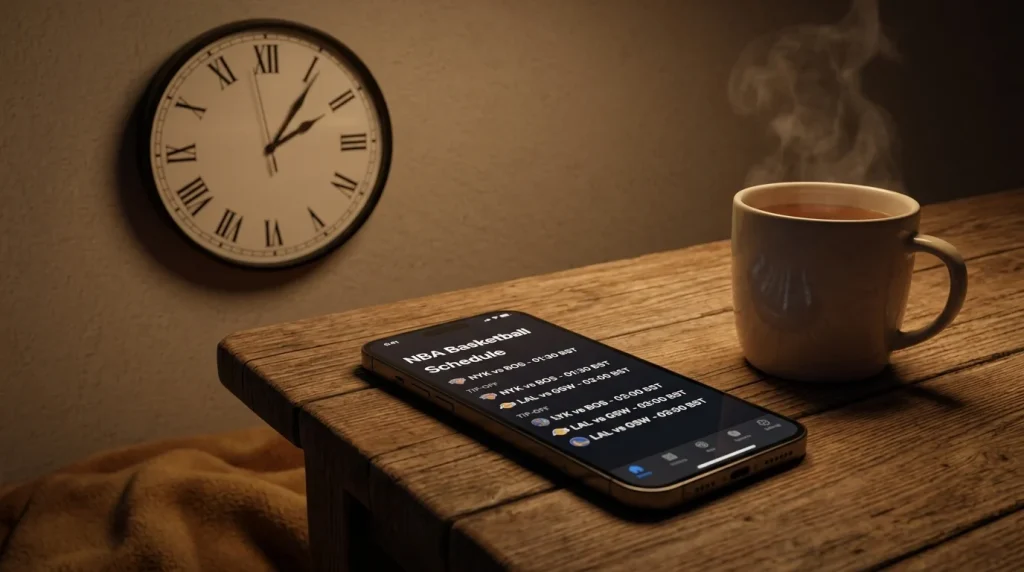
The November I Stopped Trying to Watch Every Game
My first full season properly engaging with NBA betting from the UK, I tried to watch everything. Wake up tired, work badly, eat too much caffeine, repeat. By mid-November I had built up a sleep debt that was visible in my decisions – the bets were sloppier, the bankroll was bleeding, and I was tired enough that the actual entertainment value of watching basketball had collapsed. That month broke me of the idea that watching every game was a virtue. The realisation that arrived with the sleep deprivation was that the schedule itself is the first variable to manage, before any bet is even placed.
NBA betting from a UK time zone is a structural problem before it is a strategy problem. The schedule does not bend for British circadian rhythms. The information cycles peak when British punters should be sleeping. Building a sustainable approach – sustainable in terms of bankroll, sustainable in terms of personal health – starts with mapping the calendar against the working week and figuring out what actually fits.
See also NBA London Game 2026 for a UK-friendly tip-off.
The Tip-Off Clock Translated to UK Time
The NBA’s standard tip-off windows, translated to UK time during winter, fall into four main slots. Early East Coast games tip at midnight UK time – 7pm Eastern. Late East Coast games tip at 12:30am or 1am UK. West Coast games tip at 3am or 3:30am UK during their 10pm Pacific window. Late West Coast games – the rare 7pm Pacific tips – land at 3am UK.
During British Summer Time, every tip-off shifts an hour earlier on UK clocks. Midnight tips become 11pm, 1am tips become midnight. The NBA’s regular season runs largely outside BST – October opening, February All-Star, April playoffs – but the BST transition in late March and early April creates a quirky window where the schedule is slightly more tolerable for the working UK punter.
The schedule density matters too. The NBA plays roughly 1,230 regular-season games across approximately 175 days. That averages 7 games per day, with peak Tuesday and Friday slates carrying 10 to 12 games. The UK punter who tries to follow every game across the slate is signing up for several hours of late-night engagement per day, which the body cannot sustain without consequences over a season.
Weekday Versus Weekend and Which Slates Work
The most realistic schedule for a UK punter with a regular job is to focus engagement on the weekend slates. Friday night games tipping at midnight UK and Saturday night games tipping the same hour are watchable without disrupting work the next day. Sunday afternoon and evening US games – which often tip earlier in their local schedule because of TV considerations – sometimes land at 9pm or 10pm UK time, which is genuinely viewable in real time.
The weekday slates are where the disciplined punter has to be most selective. A Tuesday game tipping at 12:30am UK with the punter due in the office at 9am the next morning is not a fixture to watch live. The realistic engagement is to place pre-game bets earlier in the evening, set alerts for status changes, sleep through the game, and review settled bets in the morning. That structure works and is the one most UK NBA bettors converge on after their first burnout season.
Marquee weekday matchups complicate this. Sky Sports broadcasts under the 11-year deal include around 100 regular season games per year. Prime Video carries another 86 games plus 6 of 11 Finals broadcasts. The marquee games attract UK viewing interest that the standard fixtures do not. Staying up for a Wednesday night Bucks-Celtics game has its place – but doing it routinely is not sustainable.
Pre-Game Research When the Window Is Smaller
The UK punter’s pre-game research window is squeezed by the time zone. For a midnight tip-off, the relevant news cycle peaks between 6pm and 11pm UK time – which is the evening hours when most working punters are doing other things. The discipline is in concentrating research into a specific block rather than letting it sprawl across the evening.
My personal pre-bet routine, before any midnight or 12:30am tip-off, is a 30-minute window between 9pm and 9:30pm UK time. Pull the official injury report. Check the relevant beat reporter feeds for the previous two hours. Review any pace or pricing notes I have logged on the matchup. Make the bet decisions. Place bets. Close the apps and step away. The discipline is in not opening the apps again after 10pm unless something specific has changed.
The temptation that has cost me the most over the years is the “one more check” pattern at 11:30pm. The line has moved. The reporter feed has updated. The hands reach for the phone, the bet gets adjusted, the position sizing gets compromised in pursuit of late information that adds noise more than signal. The 30-minute fixed window is a hard rule because the alternative is hours of inefficient monitoring that produces worse decisions, not better ones.
The Recap-Only Approach to In-Play
One framework that emerged in the UK NBA community is the “recap-only” approach to in-play betting. The punter does not bet in-play on any game during the live broadcast. All in-play activity is replaced by next-morning review of the game’s flow, which informs the next day’s bets rather than the current game’s. The trade-off is that in-play value is sacrificed in exchange for a sustainable engagement pattern that does not require 3am wakefulness.
The recap approach is structurally similar to how sharp punters in US time zones handle international markets – they engage at hours that suit their lives, accept that some real-time value is missed, and build their model on next-day data review rather than real-time reaction. For UK punters watching NBA, the same logic applies in reverse.
For punters who genuinely want to be active in-play on NBA games, the realistic compromise is to pick specific games per week – typically the Friday or Saturday marquee – and engage live only on those. Stay up for the Friday night Lakers game; sleep through the Tuesday night Hornets game. The selectivity preserves both the live engagement value and the sleep schedule.
The Sustainability Side of Late Betting
The under-discussed cost of UK NBA betting is the cumulative health cost of disrupted sleep across a 175-day season. Sleep deprivation impacts decision quality in measurable ways – risk tolerance shifts, impulse control weakens, pattern recognition degrades. The bets a tired punter makes are not the same as the bets the same punter makes well-rested. The bankroll cost is not directly visible in any single bet but is real over a sample.
The UK regulatory framework recognises this pattern in broader terms. The financial vulnerability check at the £150 threshold catches the deposit patterns that correlate with harm onset. The most common harm-onset trajectory for UK sports bettors is the late-night chasing pattern – sitting up past natural sleep time, betting in-play with declining decision quality, depositing additional funds to chase losses, and ending up in a worse position the next morning. The mechanism is structurally connected to the time zone problem that NBA bettors face uniquely among major UK sports markets.
Around 95 percent of UK online bets are placed from home. The mobile-first, late-night, in-play environment is where the bulk of recent UK gambling-harm prevention discussion has concentrated. The NBA schedule fits this pattern more cleanly than any other professional sport for UK customers. The system-level protections – limits, time-outs, deposit caps – are useful tools that the structurally disadvantaged time zone punter benefits from disproportionately.
The Display Choice That Pays For Itself
The most practical thing I have done for sustainability is to switch my book apps to a setup that does not push notifications between 11pm and 8am UK time. The line movements happen, the late scratches resolve, the in-play value windows open and close – and my phone stays quiet. The morning review captures everything that mattered. The 3am buzz that used to wake me does not.
The 30-minute pre-game window between 9pm and 9:30pm is the only engagement time on midweek slate nights. Bet placed, alerts off, day done. The Saturday and Friday slates get more sustained attention because the next morning has no work obligations. The Sunday slates – early US tip-offs that land 9pm to 11pm UK – get the full pre-game and in-play treatment because they fit the calendar.
The recap discipline on Monday morning, before opening any apps for the new week’s bets, is the close of the cycle. Previous weekend’s bets settled. Patterns logged. Watch list updated. Bankroll position checked. Then the new week starts with a clean slate and the same routine resumes.
The broadcast and viewership shift over the last two seasons has changed how engagement with the league actually feels for UK punters. NBA viewership on Prime Video in the UK rose 444 percent in 2025-26, and the cultural footprint is meaningfully larger than it was three years ago. The detail of how Prime Video coverage reshapes UK NBA engagement covers the broadcast side of the same time zone problem this piece addresses.
The NBA does not care that British punters are awake at 3am. The schedule is set for American TV audiences and that is not changing. What can change is how the UK punter structures their engagement. Selective slates, fixed pre-game windows, recap discipline, sleep protection. The bets that come out of this structure are sharper than the bets that come out of trying to watch everything.
See also nba betting help for the complete NBA betting guide.
The midnight UK time tip-off - 7pm Eastern - is the most workable for a working UK punter who wants to watch some of the game live. Pre-game decisions can be made in the 9pm to 11pm UK window, the tip happens at midnight, and the punter can watch the first quarter or two before needing to sleep. The 12:30am UK time tips are workable for placing bets but harder to watch live. West Coast tips at 3am UK time are not viable for live engagement during the working week - those are recap-only fixtures for most UK punters. For most UK punters, no. The marginal in-play value on a single West Coast game does not justify the cumulative sleep cost across a season. The exception is marquee West Coast matchups on weekend nights - a Friday Lakers-Warriors game tipping at 3:30am UK on a non-work day can be a deliberate engagement choice. Routine in-play activity on West Coast tips during the working week is one of the patterns that has historically pushed UK punters into the chasing trajectories that the regulatory framework is built to catch.Frequently Asked Questions
Which tip-off slot best fits a 9-to-5 UK working punter?
Is it worth staying up for a West Coast late tip-off to bet in-play?
